The Volume Imperative: A Strategic Guide to Sourcing Bulk Raw Coffee Beans for Industrial Scale
Dec
In our previous guide, we unlocked the value of arabica green coffee beans, defining the rigorous standards of specialty sourcing. We learned how to identify excellence in a single sample. But for the industrial roaster, the manufacturing plant, or the national retail chain, excellence in a single sample is not enough. You need excellence at scale. You need consistency across 20, 50, or 100 containers a year.
This is the transition from “sourcing” to “procurement.” This is the world of bulk raw coffee beans.
Sourcing in bulk is not just about buying more; it is a fundamental shift in strategy. It requires a move from “spot” purchasing to forward contracting. It demands a sophisticated understanding of logistics, financing, and quality assurance that can withstand the pressure of volume. A deviation of 0.5% in moisture content in a single bag is an annoyance; in a 1,000-ton contract, it is a financial disaster.
This guide is your executive playbook for managing volume. We will deconstruct the unique economics of bulk purchasing, explore the specific origins (like Vietnam) that fuel the global bulk trade, and provide a risk-management framework for executing large-scale contracts without compromising the integrity of your supply chain.
Defining “Bulk”: The Economics of Scale
When we talk about bulk raw coffee beans, we are not talking about a pallet. We are talking about the “Full Container Load” (FCL) as the minimum unit of commerce.
The Unit of Trade: The 20ft Container
- Volume: 19.2 Metric Tons (approx. 320 bags of 60kg).
- Value: At current market rates (e.g., London Robusta ~$4,500/ton), a single container is a $86,000+ asset.
- The Buyer’s Mindset: You are no longer buying “flavor”; you are buying “inventory positions.” Your primary concerns shift from “cupping notes” to “cost of carry,” “warehouse turnover,” and “hedging strategies.”
The “Cost-Plus” Advantage
The primary motivation for bulk sourcing is margin control.
- Spot Market: You pay for the importer’s warehousing, financing, and risk buffer.
- Bulk Direct: You pay the FOB Origin Price + Freight.
- The Savings: By stripping out the middleman’s margin, a bulk buyer can achieve savings of 15-30% per pound. For a roaster using 50 tons a year, this is the difference between profit and loss.
The Origins of Bulk: Vietnam’s Dominance
While every coffee country exports, few can support a true bulk raw coffee beans program. You need an origin that offers three things: Volume, Consistency, and Infrastructure.
Vietnam is the undisputed heavyweight champion of this sector.
1. The Volume Engine: Dak Lak
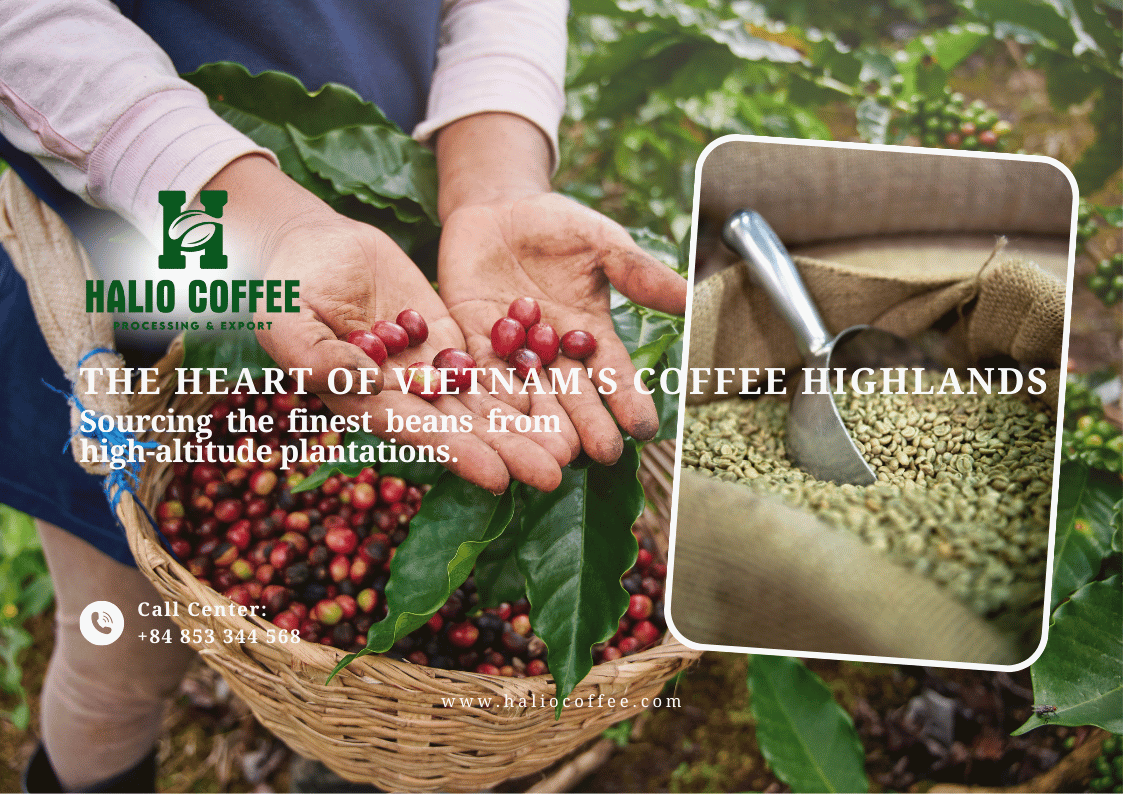
Vietnam is the world’s second-largest coffee producer, and Dak Lak province is its engine room.
- Production: Millions of bags of Robusta are aggregated here annually.
- The “Clean” Standard: Suppliers like Halio Coffee Co., Ltd have industrialized the process. They can deliver
Robusta Clean (Grade 1)by the container load, with strict specs (Black beans: max 0.1%,Broken: max 0.5%) that allow industrial roasters to “set it and forget it.” - Reliability: Unlike smaller origins where a bad rainstorm can wipe out 50% of the export crop, Vietnam’s sheer scale provides a buffer. You can book a 12-month contract with a high degree of confidence in fulfillment.
2. The Arabica Alternative: Lam Dong
For buyers needing bulk Arabica, Vietnam’s Lam Dong province is a strategic alternative to Brazil or Honduras.
- The Product:
Arabica S18 Fully Washed. - The Advantage: Sourcing bulk Arabica from Vietnam allows Asian and European buyers to diversify their risk away from South America, often with shorter transit times and competitive pricing structures.
The Quality Control Challenge: Consistency at Scale
The biggest risk in bulk buying is “fade.” A sample might be perfect, but can the supplier replicate that perfection across 10 containers?
The “Type Sample” vs. “Stock Lot”
- Small Buyer: Approves a specific, existing lot (e.g., Lot #402).
- Bulk Buyer: Approves a “Type Sample”. This is a benchmark. You are contracting for 20 containers that match this profile over the next 12 months.
- The Risk: Quality drift. The harvest changes. The first container is great; the fifth is mediocre.
- The Solution:Standardized Specs. You cannot rely on “tastes like chocolate.” You must contract on physics:
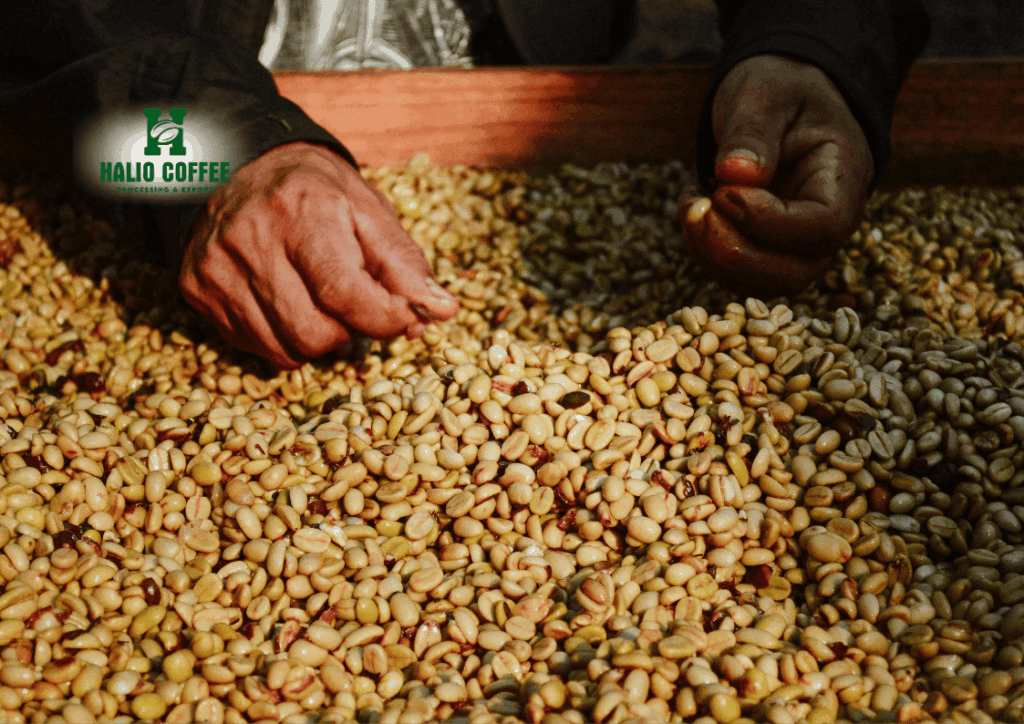
- Screen Size: Strict retention (e.g., “90% on Screen 18”).
- Defect Count: Absolute limits (e.g., “Max 1% Black/Broken”).
- Moisture: A hard cap of 12.5% to prevent mold in large stockpiles.
The Homogenization Necessity
A bulk supplier must have large-scale milling infrastructure.
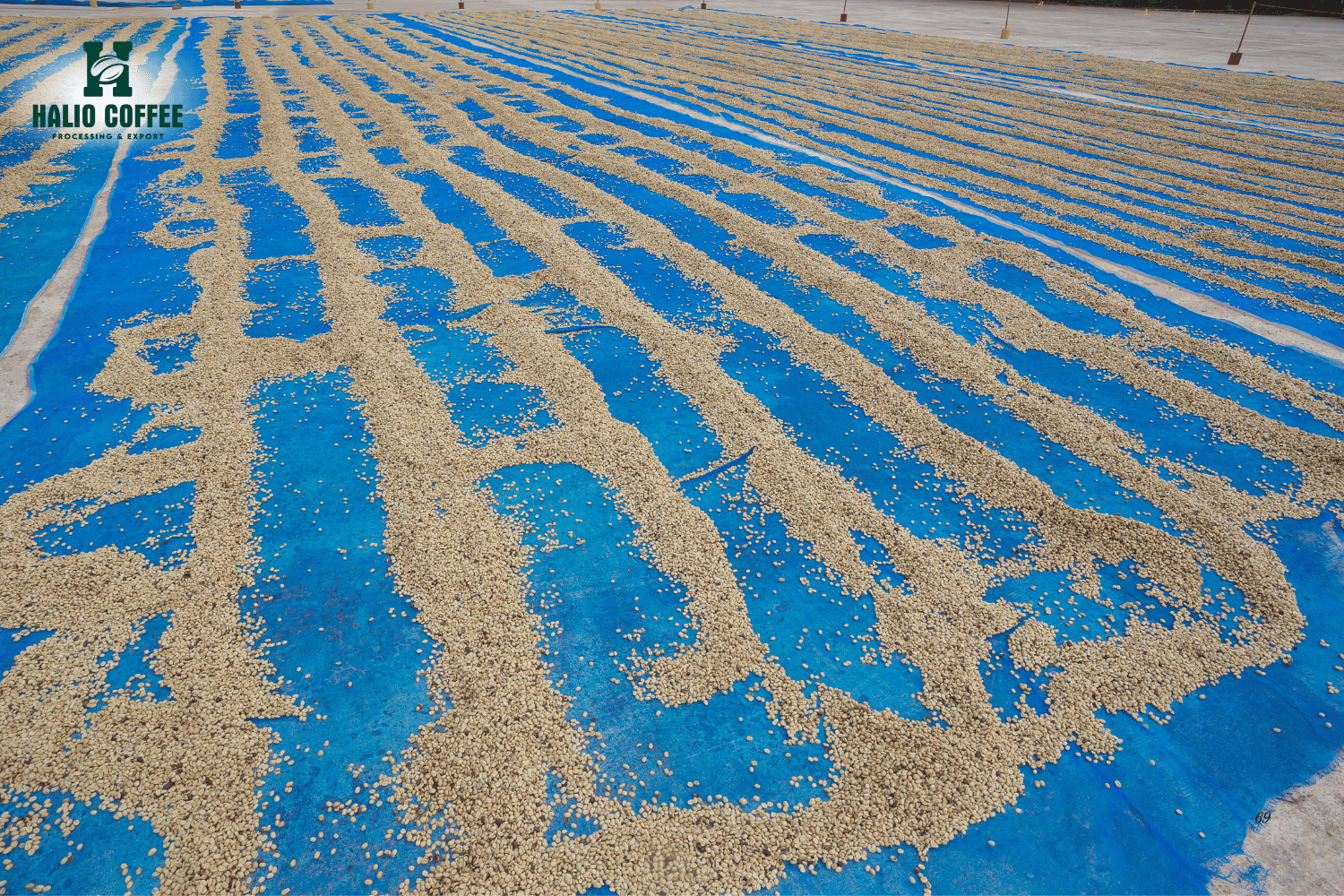
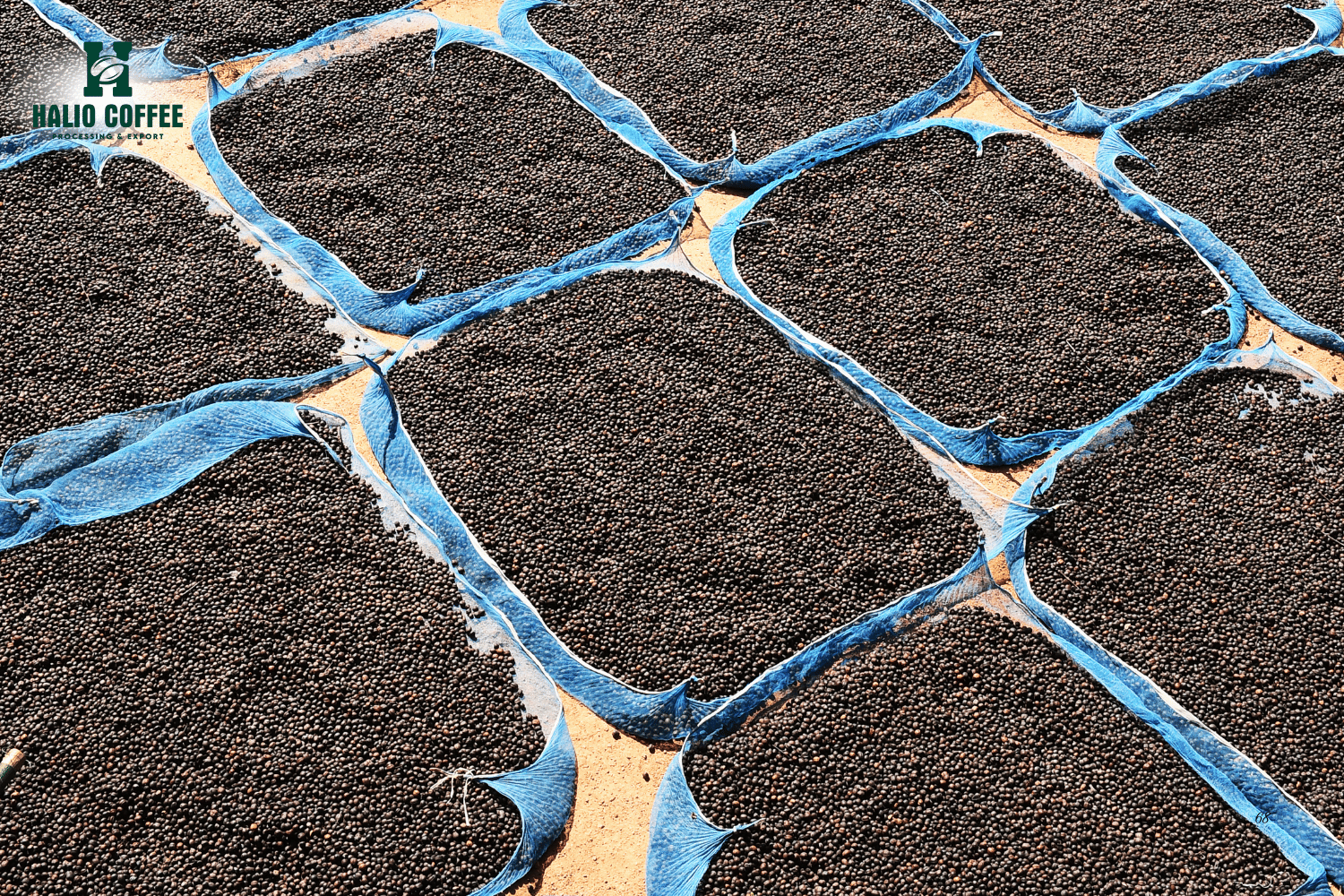
- The Process: They must be able to blend day-lots from hundreds of farmers into a single, uniform export lot.
- The Audit: When vetting a bulk supplier (like Halio), look for their silo capacity and mixing equipment. A small mill can produce a great micro-lot; only a large mill can produce a consistent 100-ton macro-lot.
The Financial Mechanics: Hedging the Bulk
When you buy bulk raw coffee beans, you are exposed to the global commodities market.
- Scenario: You sign a contract for 10 containers at a fixed price of $4,500/ton. Two months later, the London market crashes to $3,800/ton. You are now overpaying by $700/ton ($134,000 total loss). Your competitors are buying cheap and undercutting you.
The “PTBF” (Price To Be Fixed) Defense
Professional bulk buyers rarely use “Fixed Price” contracts. They use PTBF.
- Contract: You agree on the Differential (the premium for quality, e.g., +$200/ton) and the Volume (10 containers).
- Trigger: You leave the Base Price (London Futures) open.
- Action: You watch the market. When the chart dips (like the drop to $4,501 on Oct 20), you “fix” the price for one or two containers.
- Result: You get the security of supply with the flexibility of market timing.
The Supplier’s Role: A supplier like Halio Coffee, which acts as a “Manufacturer, Supplier & Exporter”, is essential here. They must have the financial sophistication to manage these hedging positions with you.
Logistics: The “Pipeline” Strategy
In bulk sourcing, you don’t just ship coffee; you manage a pipeline.
The “Spread Shipment”
You don’t want 10 containers arriving on the same day (your warehouse will explode).
- The Strategy: Negotiate a “Spread Shipment” schedule (e.g., “2 containers per month, Jan-May”).
- The Benefit: This smooths your cash flow and keeps your inventory fresh.
- The Cost: You may pay a “carry charge” (interest + storage) for the later months, but it is cheaper than renting external warehousing in your home country.
The “Drop-and-Hook” Efficiency
For high-volume receivers, work with your freight forwarder to set up “drop-and-hook” deliveries. The truck drops the full container and picks up the empty one from the last delivery immediately. This eliminates “live unload” waiting fees and keeps your dock moving.
Buyer’s Checklist: Vetting for Bulk Capability
Not every supplier can handle bulk. Use this audit to filter your partners.
1. The Capacity Audit
- Question: “What is your daily milling output?”
- Why: If they can’t process a container a day, they will become a bottleneck during peak season.
2. The Financial Audit
- Question: “Can you offer PTBF contracts?”
- Why: If they can’t, they are likely a small trader without a brokerage account. You will be forced into risky Fixed Price contracts.
3. The Infrastructure Audit
- Question: “Do you have color sorters and density tables?”
- Why: You cannot produce
Grade 1bulk Robusta consistently by hand-sorting. Machine sorting is mandatory for scale.
4. The Packaging Audit
- Question: “Can you pack in Bulk Container Liners?”
- Why: For massive industrial clients, 60kg bags are inefficient. A “Bulk Liner” turns the whole container into a single 21-ton bag. A bulk supplier must know how to load this.
Conclusion: The Power of Scale
Sourcing bulk raw coffee beans is the industrialization of your passion. It requires a shift from “tasting” to “testing,” from “buying” to “hedging,” and from “shipping” to “logistics.”
By partnering with a capable, vertically integrated manufacturer like Halio Coffee—one who can deliver High Quality and Proper Processing at container volume—you secure the foundation of your business. You gain the margin to grow, the consistency to retain customers, and the resilience to weather market storms.
You have now built the machine. You have the volume, the price, and the logistics. The final step is execution. You need to pull the trigger. You need to place the order.
It is time to learn the specific tactical steps to order green coffee beans and initiate the flow of goods.
- The 2026 Procurement Strategic Guide: How to Buy Unroasted Coffee Beans for Margin and Resilience
- Analyzing Raw Coffee Beans for Sale in a Divergent Market
- Coffee Prices Today, Nov 15: London’s 5th Consecutive Drop, Domestic Prices Fall Below 110,000 VND/kg
- The New Cost of Compliance: Deconstructing the Vietnam Traceable Green Coffee Bean Price EU
- Coffee Prices Today, October 28th: Both Exchanges Drop Sharply on Signals of US Easing Tariffs on Vietnam