The 2026 Procurement Strategic Guide: How to Buy Unroasted Coffee Beans for Margin and Resilience
Jan
In the global beverage economy, the finished cup—the latte art, the extraction yield, the sensory profile—is merely the final flourish of a complex, high-stakes supply chain. The true engine of profitability, the variable that determines the ceiling of quality and the floor of cost, is the decision to buy unroasted coffee beans. As we navigate the opening weeks of 2026, the market for this raw material has shifted from a monolithic commodity trade into a bifurcated landscape of extreme risk and unprecedented opportunity.
In our previous analysis on how to source green coffee from Vietnam, we established the geographical importance of the Central Highlands. Now, we must pivot to the transactional and technical execution. For the professional buyer, the current environment is defined by a distinct “divergence.” On one side of the globe, Brazil—the traditional titan of Arabica—is grappling with heatwaves that threaten the structural integrity of future harvests. On the other, Vietnam is flooding the market with record volumes of Robusta, creating a liquidity event that savvy procurement teams are using to stabilize their balance sheets.
This guide is your executive manual for sourcing. We will move beyond the basic agronomy to dissect the commercial realities of the current market. We will analyze the 18% price correction in Vietnam, evaluate the technical specifications of “Wet Polished” beans, and provide a rigorous due diligence framework to ensure that when you buy unroasted coffee beans, your supply chain remains resilient, compliant, and profitable.
Market Analysis: The Strategic Window to Buy Unroasted Coffee Beans
Why is Q1 2026 the critical moment for procurement? The answer lies in the data. The global market is currently experiencing a “Buyer’s Window” for Asian origins, acting as a counter-balance to the scarcity seen in the Americas.
The Price Correction Opportunity
The most significant metric for 2026 is the price adjustment in the world’s largest Robusta origin.
- The Data: As of January 7, 2026, fresh unroasted coffee beans in Vietnam are trading between 97,500 and 98,300 VND/kg.
- The Delta: This represents a sharp decrease of approximately 18% (21,100 – 21,400 VND/kg) compared to the same period in 2025.
- The Driver: This is not a demand failure; global consumption is at a record 169–170 million bags. Rather, it is a liquidity event driven by “aggressive selling” from farmers eager to clear warehouse space before the Tet holiday.
The Export Surge
While Brazil’s exports faltered in late 2025 (down 27% in November), Vietnam is aggressively moving inventory into the global stream.
- Volume Velocity: In the first two months of the 2025-2026 crop year, Vietnam exported 2.63 million bags, a massive 51.9% increase year-on-year.
- Strategic Implication: This surge proves that despite earlier fears of storms, the logistics chain is intact. For buyers, this means physical availability is high, reducing the risk of shipment defaults that plagued 2024.
Expert Insight: Smart procurement teams are using this 18% discount to lower their “Weighted Average Cost of Goods” (WACOG). By locking in core volumes when you buy unroasted coffee beans from Vietnam now, you create a financial buffer against the potential Arabica spikes expected later in the year.
Defining the Asset: What to Look for When You Buy Unroasted Coffee Beans
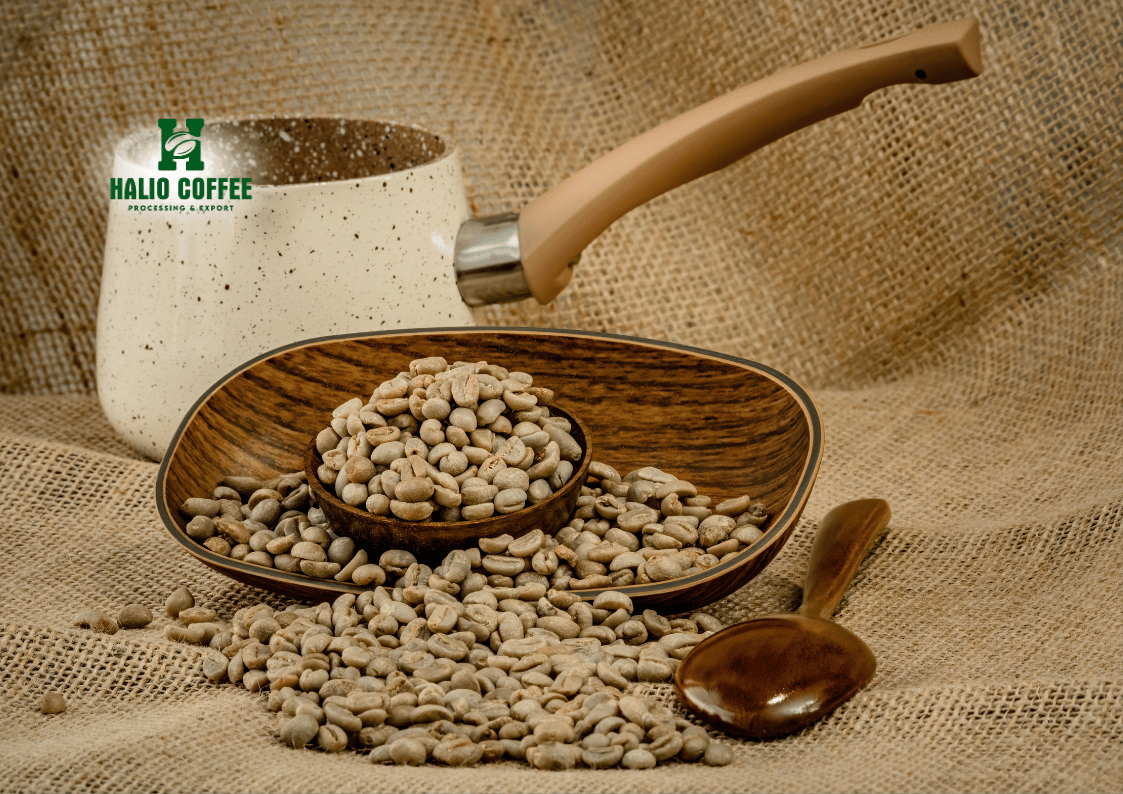
To source effectively, one must first deconstruct the asset. Unroasted coffee beans, often referred to within the industry as “green coffee,” are the seeds of the Coffea fruit, processed and dried to a stable moisture content. In 2026, it is no longer sufficient to treat this product as a generic commodity; it must be understood as a precision ingredient.
The Species Divide in 2026
The market is split into two primary genetic lineages, each serving a distinct commercial function.
- Coffea Arabica (The Value Driver): Historically prized for acidity and complexity. However, as of late 2025, Arabica futures have risen approximately 9%, trading near 348.75 US cents/lb. This price inflation is driven by “structural vulnerability” in Latin American origins, forcing roasters to be surgical in their procurement.
- Coffea Canephora (Robusta – The Volume Driver): This is the current anchor of the global trade. Sourced primarily from Vietnam, these beans provide body, crema, and caffeine. In 2026, the “Fine Robusta” movement is elevating this species from a filler to a feature, utilizing advanced processing to strip away harsh phenolic notes.
The Processing Revolution: Wet Polished
When you prepare to buy unroasted coffee beans for commercial blends in 2026, the most strategic upgrade is “Wet Polished.”
- The Mechanism: Beans are subjected to high-pressure water friction. This removes the silverskin and the outer layers of cellulose.
- The Result: A cleaner, brighter cup profile. The “earthy” or “woody” notes associated with commodity Robusta are scrubbed away, leaving a neutral, heavy-bodied base.
- The Application: This allows roasters to use a higher percentage of Robusta in blends without negatively impacting consumer perception, effectively arbitrageing the cost difference between species.
The Technical Audit: Quality Control Framework
In the B2B context, you are purchasing a technical specification. Specificity is your only defense against “quality fade.” Do not rely on generic grade descriptions like “Grade 1.” Demand the following technical parameters.
Moisture Content: The Critical Control Point
With the massive volume currently moving through ports, the risk of “ship’s sweat” is elevated.
- The Standard: Strict adherence to 12.0% – 12.5% moisture.
- The Logic: Suppliers may try to push this to 13% to gain weight. Reject any lot over 12.5%. Excess moisture in unroasted coffee beans accelerates chemical degradation and invites mold (Ochratoxin A) during the 4-6 week ocean transit.
Physical Grading (The TCVN 4193:2005 Standard)
For a premium commercial contract, demand:
- Black & Broken: Max 2%.
- Foreign Matter: Max 0.5% (This is critical; stones destroy roaster drums).
- Excelsa/Catimor Admixture: Max 0.5%. You want pure species consistency.
- Screen Retention: Min 90% on Screen 18 (7.1mm) or Screen 16 (6.3mm). Uniform screen size ensures uniform heat transfer during roasting.
The Sensory Audit
Even for commercial lots, the “clean cup” is non-negotiable.
- The Test: Roast a sample to Agtron 55. Cup blindly.
- The Fail: Any note of Phenol (medicine/iodine), Ferment (rotten fruit), or Mold. Optical color sorters used by advanced manufacturers (like Halio Coffee) are designed to eliminate the black beans that cause these defects.
Vetting Suppliers Before You Buy Unroasted Coffee Beans
The ecosystem of suppliers is vast, ranging from smalltime collectors to multinational giants. Vetting is crucial to avoid contract defaults.
The Manufacturer vs. The Trader
- The Trader: Buys parchment from collectors and sells to you. They offer liquidity but low traceability.
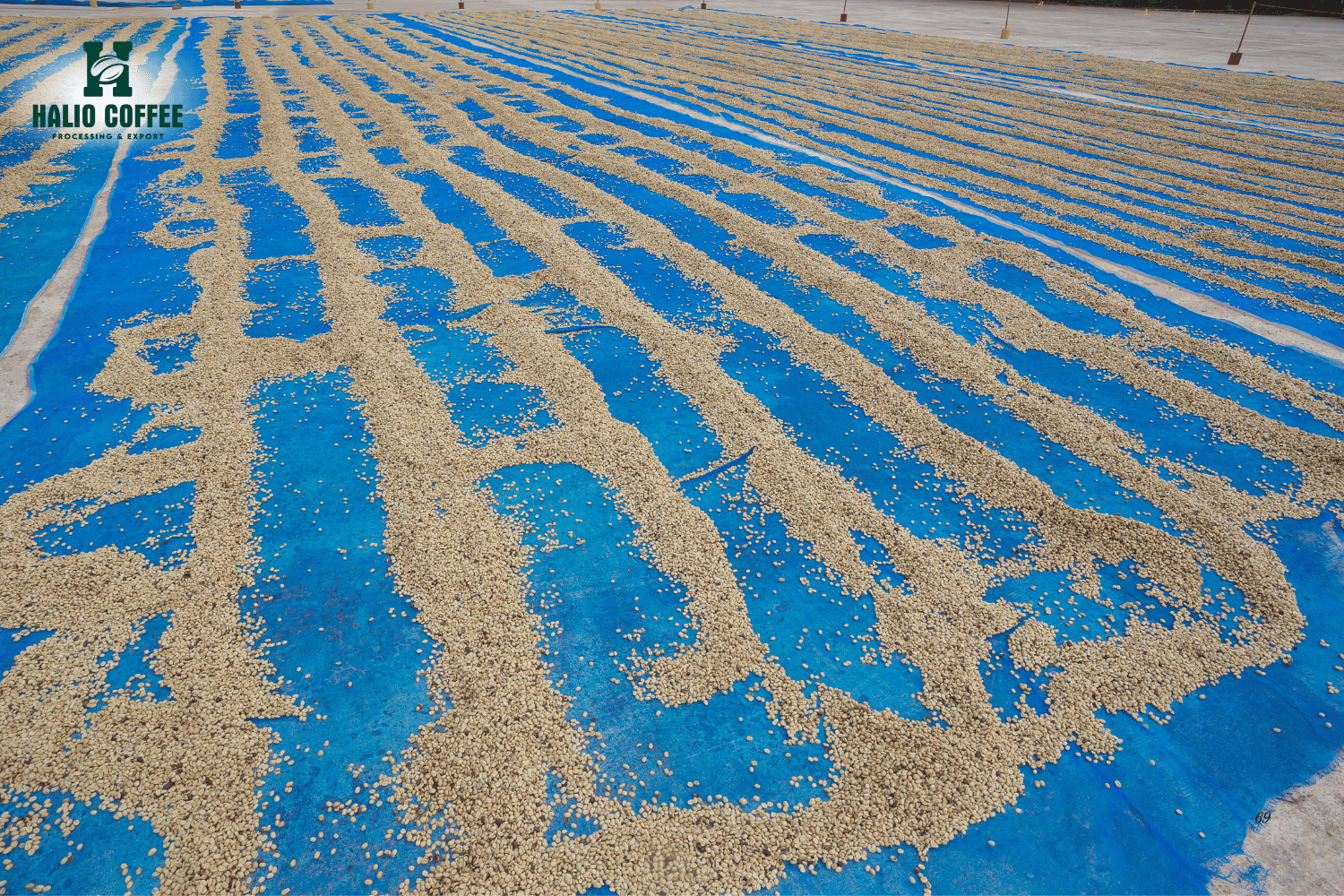
- The Manufacturer: Owns the dry mill in Dak Lak or Gia Lai. They control the drying patio and the color sorters.
- Recommendation: Always source from the manufacturer. In a year where domestic prices dropped 18%, traders are under margin pressure and more likely to blend in lower-quality beans.
EUDR Compliance (The 2026 Mandate)
The European Union Deforestation Regulation (EUDR) is the defining constraint of 2026.
- The Challenge: The Central Highlands has thousands of smallholder farmers.
- The Solution: Professional suppliers are investing in GPS mapping of their farm networks. When you buy unroasted coffee beans, demand to see the geolocation data for the specific lot. If a supplier offers a “general region certificate,” they are non-compliant.
Financial Resilience
- Terms: Look for suppliers who can offer FOB Ho Chi Minh City terms. This gives you control over the freight.
- Capacity: Ensure the supplier has the warehouse capacity to store beans properly if shipment is delayed. The dry weather is good for harvest, but once beans are bagged, they need cool, dry storage.
Logistics: Protecting the Asset in Transit
Once you have secured the contract to buy unroasted coffee beans, the logistics of moving them from origin to your warehouse are the final hurdle.
Packaging: The GrainPro Standard
- The Issue: Jute bags are breathable. In a humid container crossing the equator, beans can re-absorb moisture, leading to “baggy” flavors or mold.
- The Solution: Specify GrainPro or Ecotact hermetic liners for all shipments. The small premium (cents per pound) pays for itself by preserving the freshness and water activity of the beans.
Timing the Shipment
- The Constraint: The Tet Lunar New Year often shuts down logistics in Vietnam for two weeks.
- The Strategy: With exports currently surging, ensure your bookings are confirmed well before the holiday window to avoid your cargo getting stuck at the port of Ho Chi Minh City.
Risk Management: Red Flags in the 2026 Market
The current abundance of supply in Vietnam creates a “Buyer’s Market,” but it also attracts opportunistic behavior. Be vigilant against these specific risks.
The “Past Crop” Blend
With new crop prices trading 18% lower than last year’s carryover stock, some suppliers may attempt to blend old, woody beans with fresh harvest to clear their dead stock.
- The Detection: Use the “Visual and Olfactory” test. Fresh unroasted coffee beans are blue-green and smell grassy/vegetal. Old crop is pale/whitish and smells like straw, wood, or burlap.
- The Defense: Require a “Crop Year 2025/2026” certificate and approve a Pre-Shipment Sample (PSS) that is drawn by a third party.
The Moisture Scam
A supplier offers a price $20/ton below market but delivers coffee at 13.5% moisture. You are paying for water, and you will receive mold. Buying water at the price of coffee is the oldest trick in the book.
Capitalizing on the Divergence
Sourcing unroasted coffee beans in early 2026 is an exercise in strategic arbitrage. You have the opportunity to leverage the 18% price correction in Vietnam to secure the high-volume foundation of your business, while simultaneously using those savings to hedge against the rising costs and climate risks of the Arabica market.
However, this window is finite. The current liquidity is driven by harvest pressure. As domestic stocks tighten and the global “structural vulnerability” reasserts itself, the power balance will shift back to the seller. The time to lock in your position—demanding “Wet Polished” quality and full traceability—is now.
You have secured the physical asset. Now, the final step in your procurement journey is to understand the exact financial metrics that determine the landing cost.
- Organic Robusta Coffee Distributors
- Mastering the Art of the Green Bean Roaster
- Vietnam Green Arabica Coffee Export: Rising Potential in the Global Market
- Timing is Everything: Your Definitive Vietnamese Coffee Harvest Season Guide
- The Strategic Procurement of 2026: A Professional Guide to Buying Raw Coffee Beans