The Architect of Supply: Selecting the Right Green Bean Company in 2026
Jan
In the intricate, high-stakes architecture of the global coffee trade, the entity that stands between the farm gate and the roaster’s loading dock is the single most critical variable in the supply chain. This entity—the green bean company—is no longer a mere logistical conduit or a paper-pushing intermediary. As we navigate the opening weeks of 2026, the role of these companies has fundamentally transformed.
The global market is currently defined by a sharp divergence. On one side, we face “structural vulnerability” in the Arabica sector due to climate shocks in Brazil. On the other, Vietnam is flooding the market with liquidity, offering an 18% price correction on Robusta. In this volatile environment, a green bean company must function as a risk manager, a compliance officer (specifically for EUDR), a quality manufacturer, and a financial strategist.
For the professional procurement director, the question is not just “What coffee can I buy?” but “Who am I buying it from?” This guide is your executive manual for evaluating, vetting, and partnering with a green bean company in 2026. We will move beyond the glossy brochures to dissect the operational realities, the infrastructure requirements, and the financial resilience that distinguish a strategic partner from a liability.
1. The Evolution of the Green Bean Company: From Trader to Manufacturer
To source effectively, one must understand the taxonomy of the industry. The term green bean company is a catch-all that obscures a vast spectrum of operational capabilities. In 2026, the market has bifurcated into two distinct models.
The Legacy Model: The Commercial Trader
For decades, the dominant form of the green bean company was the pure trader.
- Operational Model: Asset-light. They sit in offices in Ho Chi Minh City, London, or New York. They buy parchment or semi-processed green coffee from local collectors, aggregate it, and sell it to roasters.
- The Value: Liquidity and market access.
- The 2026 Risk: In a market where domestic prices have dropped 18%, traders operating on thin margins are under immense pressure. They lack control over the physical processing. If a local collector mixes “past crop” with “new crop” to save money, the trader often cannot detect it until the coffee is already on the water.
The Modern Model: The Vertically Integrated Manufacturer
This is the strategic partner of choice for 2026. Companies like Halio Coffee represent this shift.
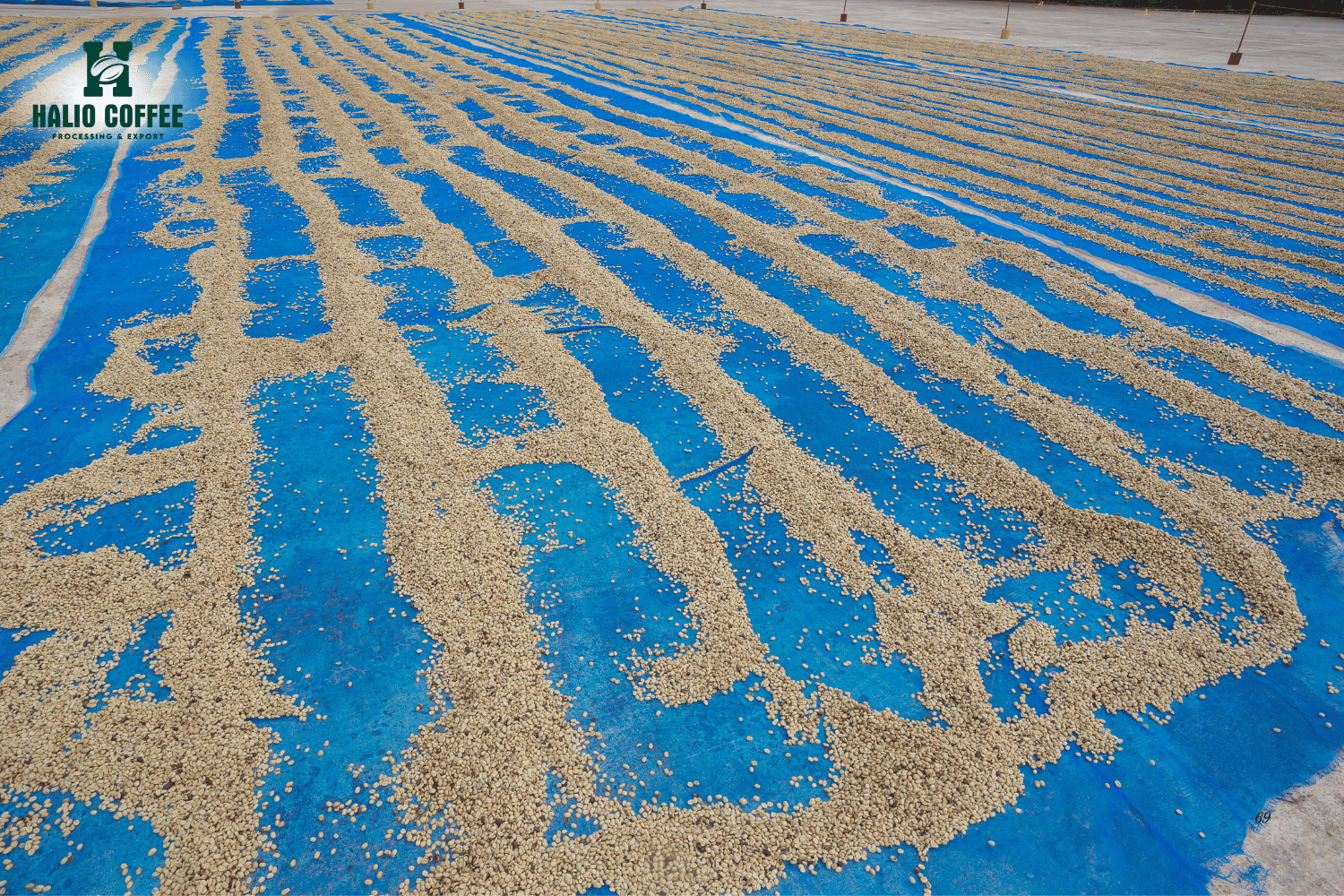
- Operational Model: Asset-heavy. This type of green bean company owns the infrastructure: the wet mills in the highlands, the drying patios, the silos, and the optical sorting lines.
- The Value: Control. They do not “find” coffee; they “manufacture” it to a spec.
- The 2026 Advantage: With the EU Deforestation Regulation (EUDR) now in force, only a green bean company that controls the supply chain from the farm level can accurately provide the required geolocation data polygons.
2. Market Analysis: Why the Right Green Bean Company Matters Now
Why is partner selection the critical variable in Q1 2026? The answer lies in the specific market dynamics we are witnessing right now.
Navigating the Liquidity Event
As of January 8, 2026, Vietnam is experiencing a massive liquidity event.
- The Data: Exports have surged 51.9% year-on-year, and prices have corrected to 97,500 – 98,300 VND/kg.
- The Role of the Green Bean Company: A capable partner helps you navigate this “Buyer’s Window.” They have the warehouse capacity to accumulate stock while prices are low (the “aggressive selling” phase) and the financial strength to hold it for you under a “Price To Be Fixed” (PTBF) contract. A weak company will force you to buy Spot, exposing you to market volatility.
The Quality Firewall
While volume is high, the risk of quality fade is real.
- The Context: With exports surging, logistics are strained.
- The Defense: A competent green bean company acts as a firewall. They utilize their own labs to test every truckload for moisture (max 12.5%) and phenol. They ensure that the massive volume moving through the system does not compromise the specific Grade 1 standards of your contract.
3. Operational Vetting: How to Audit a Green Bean Company
When evaluating a potential partner, do not rely on their website or LinkedIn profile. You must audit their physical and operational reality. Use this framework to assess any green bean company claiming to be a leader in Vietnam.
Phase 1: The Infrastructure Audit
You are buying access to machinery. Verify it exists.
- Optical Sorting: Does the green bean company own Buhler or Sortex machines? In 2026, mechanical grading (sieves) is not enough to guarantee a clean cup. Optical sorters are mandatory to remove black beans and foreign matter.
- Silos and Storage: Look for vertical silos. Coffee stored in silos is homogenized (blended) to create consistent lots. Coffee stored in piles on a warehouse floor is subject to moisture variance and pest infestation.
- Polishing Lines: If you require “Wet Polished” Robusta (a key strategy for 2026), does the company own the polishing line? Outsourcing this process is a major bottleneck.
Phase 2: The Compliance Audit (EUDR)
This is the binary pass/fail metric for European buyers in 2026.
- The Question: “Show me your data stack.”
- The Red Flag: If a green bean company hands you a folder of paper certificates or a general map of Dak Lak province, walk away.
- The Standard: A professional company will demonstrate a digital dashboard showing the polygon coordinates of the specific farm clusters contributing to their lots, cross-referenced with satellite imagery to prove zero deforestation post-2020.
Phase 3: The Financial Stress Test
In a market where prices have dropped 18%, inventory devaluation is a killer.
- The Risk: A green bean company that bought long positions at the peak of 2025 is now sitting on massive paper losses. They may be facing a liquidity crisis.
- The Check: Request references from their logistics providers. Are they paying their freight forwarders and trucking companies on time? A company that is slow to pay logistics vendors is a company on the brink of default.
4. Technical Capabilities: What to Demand
A modern green bean company should be able to deliver more than just a 60kg bag of raw material. They should offer technical solutions that improve your roasting efficiency.
Value-Added Processing
- Wet Polished Robusta: As Arabica prices rise, you need a Robusta that can hide in a blend. A top-tier green bean company will offer high-pressure washed Robusta that mimics the visual and sensory profile of Arabica.
- Custom Screening: Standard is Screen 18. A strategic partner can customize this (e.g., Screen 19 or Peaberry separation) to match your specific roasting profile.
Logistics Optimization
- Bulk Liner Capability: For large roasters, buying in jute bags is inefficient. A capable green bean company will have the specialized equipment to load 21-ton Bulk Container Liners. This saves you freight costs (approx. 2 tons free per container vs. bags) and protects the coffee better against moisture.
- GrainPro Integration: They should treat GrainPro or Ecotact liners as a standard operating procedure, not a “special request” that delays shipment.
5. Strategic Alignment: The Partnership Model
In 2026, the transaction is less important than the relationship. How does the green bean company align with your long-term goals?
The “Open Book” Approach
Traditional traders hide their margins. Modern manufacturers often work on an “Open Book” or “Toll Milling” basis.
- The Model: You pay the farm-gate price + a fixed milling and handling fee.
- The Benefit: In a year like 2026, where farm-gate prices are transparent and low, this model ensures you get the full benefit of the market correction, rather than the supplier padding their margin.
Innovation Partnership
Is the green bean company investing in the future?
- R&D: Are they experimenting with Anaerobic Fermentation or Honey Processing?
- Agriculture: Are they distributing seedlings or supporting irrigation projects? A company that invests in its farmers is a company that will still have supply when the next climate shock hits.
6. Red Flags: Warning Signs of a Liability
Be vigilant. The label green bean company can be applied to a fly-by-night operation just as easily as a multinational. Watch for these signals.
- 🚩 The “Ghost Office”: The company claims to be a major exporter but their registered address is a shared co-working space or a residential building, and they refuse site visits.
- 🚩 The “Negative Differential”: They offer you a price that is mathematically impossible (e.g., below the London Terminal + replacement cost). They are likely planning to ship defective goods, high-moisture coffee (selling water), or default on the contract if the market moves against them.
- 🚩 The “Crop Year” Haze: They are vague about whether the coffee is 2025/2026 crop or carryover. With the 18% price drop, they have a massive incentive to dump old, woody stock on unsuspecting buyers.
7. Comparative Analysis: Manufacturer vs. Trader
To crystalize the decision process, use this comparison table when evaluating a green bean company.
| Feature | Vertically Integrated Manufacturer | Commercial Trader |
| Asset Control | Owns Mills, Silos, Sorters | Rents Capacity / Buys FOB |
| Traceability | Farm-to-Container (Polygon Data) | Collector-to-Port (Paper Trail) |
| Quality Consistency | High (Machine Controlled) | Variable (Dependent on Supplier) |
| Pricing Model | Processing Margin / Cost Plus | Speculative / Arbitrage |
| Risk of Default | Low (Physical Asset Backing) | Medium/High (Market Dependent) |
| Best For… | Strategic, Long-term Programs | Spot / Commodity Volume |
Summary: The Architect of Your Supply Chain
Selecting the right green bean company in 2026 is the single most effective hedge against global volatility. By partnering with a vertically integrated manufacturer in Vietnam, you secure access to the world’s most robust supply engine at a price point that has corrected by 18%.
You are not just buying coffee; you are buying the infrastructure, the compliance data, and the financial stability of your partner. In a market defined by divergence—where Arabica is scarce and Robusta is plentiful—the right green bean company allows you to arbitrage this spread, stabilizing your blend costs and ensuring your product remains consistent on the shelf.
You have now identified the ideal partner profile. The next step is to understand the macro-agronomic landscape that these companies operate within to predict future supply trends.
- EUDR Compliant Coffee Supplier Vietnam: Preparing for the Future of Sustainable Trade
- Coffee Price Today, August 5: Robusta Surges Above US$3,400/ton on Brazil Drought and Strengthening Real
- Coffee Prices Today, September 3: Sharp Decline for the Second Consecutive Day
- The Professional Buyer’s Guide to Green Bean Kopi: From Commodity Staple to Specialty Craft
- A 2026 Strategic Guide to Buy Green Coffee Beans in Bulk