Mastering the Art of the Green Bean Roaster
Dec
In our comprehensive analysis of the coffee value chain, we have dissected the biological anatomy of raw coffee beans, defined the unified product identity of the green bean coffee, and mastered the rigorous vetting protocols for selecting the best green coffee beans. You have secured a high-potential asset. Now, you must transform it.
This brings us to the pivotal role of the green bean roaster.
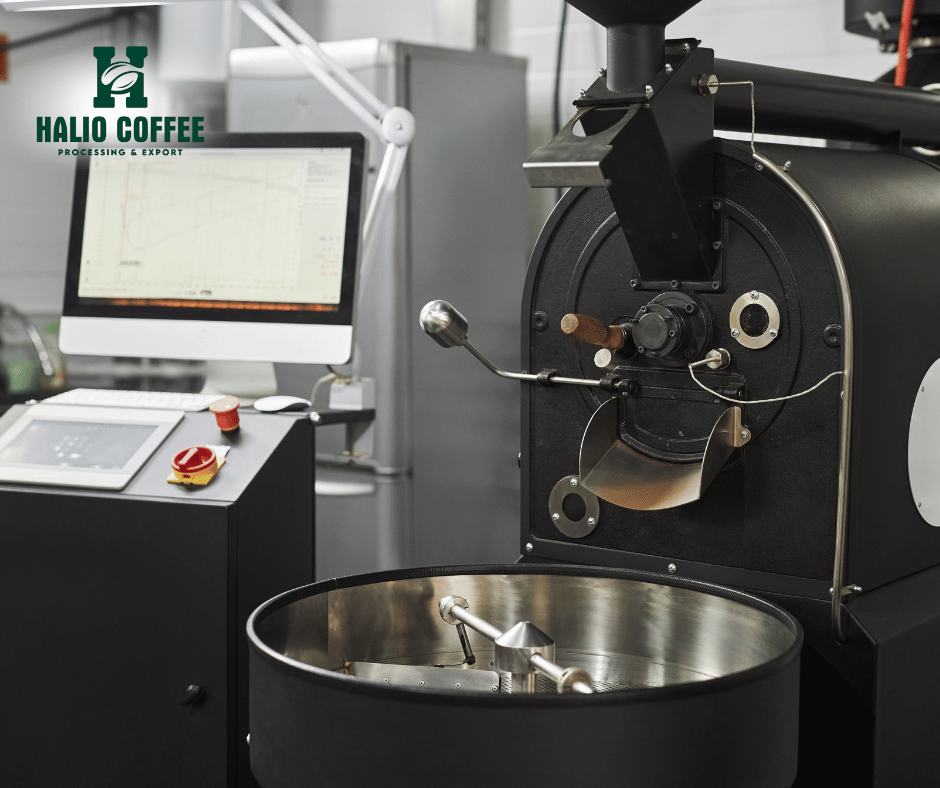
This term does not just refer to the machine; it refers to the professional—the artisan-scientist who stands between the farm and the cup. To be a green bean roaster is to be a master of thermodynamics, chemistry, and sensory analysis. It is the responsibility of taking a stable, potential-filled seed and applying energy with such precision that you unlock its specific “source code” of flavor without destroying it.
For the B2B buyer or aspiring roaster, understanding this process is critical. You cannot effectively source green coffee if you do not understand how it will behave in the drum. This guide is your technical manual. We will move beyond “light vs. dark” to explore the physics of heat transfer, the chemistry of the Maillard reaction, and the specific roasting strategies required for the diverse origins of Vietnam, from the high-altitude Arabicas of Lam Dong to the bold Robustas of Dak Lak.
The Physics of Transformation: How a Green Bean Roaster Works
At its core, coffee roasting is the application of heat to a seed to drive chemical changes. But the way that heat is applied defines the result. A green bean roaster must master three modes of heat transfer.
1. Conduction (Contact Heat)
This is heat transferred by direct contact.
- The Mechanism: The green beans touch the hot metal surface of the roasting drum.
- The Role: Critical in the early “drying phase” to impart energy into the bean’s core.
- The Risk: Too much conduction leads to scorching or “tipping” (burning the surface before the inside is cooked). This is a major risk for softer, lower-density beans like some natural Robustas.
2. Convection (Air Heat)
This is heat transferred by moving hot air.
- The Mechanism: A fan pulls hot air from the burner through the tumbling mass of beans.
- The Role: This is the primary driver of modern roasting. It cooks the bean evenly from all sides and carries away smoke and moisture.
- The Advantage: Convection is gentle and precise. It allows for the development of bright acidity and delicate floral notes, essential for high-altitude beans like the
Arabica S18 Fully Washed | Specialty | Lam Dong Origin.
3. Radiant (Stored Heat)
This is heat radiating from the hot metal of the roaster itself.
- The Role: It provides a stable thermal baseline, ensuring the roast doesn’t “stall” (drop in temperature) when you add cold beans.
The Roasting Curve: Navigating the Three Phases
A roast is not a straight line; it is a curve. The green bean roaster must manage the “Rate of Rise” (RoR)—the speed at which the bean temperature increases—through three distinct phases.
Phase 1: The Drying Phase (Endothermic)
- The Goal: To evaporate the free moisture (that 10-12.5% we measured in the green bean).
- The Chemistry: The bean turns from green to yellow. It smells like hay or grass.
- The Strategy: For high-moisture beans (e.g., 12.0%), you need a longer drying phase to ensure the water evaporates from the core before the outside starts to brown. If you rush this with high heat, you get a “grassy” inside and a burnt outside.
Phase 2: The Maillard Phase (The Flavor Factory)
- The Goal: To develop flavor and body.
- The Chemistry: At around 150°C (300°F), the beans turn yellow-brown. The amino acids and reducing sugars react (the Maillard Reaction), creating hundreds of aromatic compounds: nutty, caramel, chocolate, and savory notes.
- The Strategy:
- For Body: Extend this phase. A longer Maillard phase creates more melanoidins (heavy molecular weight compounds), adding texture and mouthfeel. This is perfect for a
Robusta Cleanespresso blend. - For Acidity: Shorten this phase. A faster transit preserves the delicate organic acids (citric, malic). This is ideal for a
Son La Full Washed Arabica.
- For Body: Extend this phase. A longer Maillard phase creates more melanoidins (heavy molecular weight compounds), adding texture and mouthfeel. This is perfect for a
Phase 3: Development (The Finish)
- The Goal: To balance acidity with sweetness and solubility.
- The Event: First Crack. At around 196°C (385°F), the pressure of steam and CO2 inside the bean causes it to crack open with an audible “pop.” The bean becomes exothermic (releasing heat).
- The Strategy:
- Light Roast: Drop the beans shortly after First Crack (15-20% development time). This preserves the “origin character”—the floral and fruit notes of the terroir.
- Medium/Dark Roast: Continue roasting towards (or into) Second Crack. This burns off acidity and caramelizes sugars further, creating roast-driven flavors (chocolate, toast, smoke).
Origin-Specific Strategies: Roasting Vietnam’s Best
A skilled green bean roaster does not use one profile for everything. You roast the bean, not the machine. Vietnam’s diverse origins require specific approaches.
Strategy 1: Roasting High-Altitude Arabica (Lam Dong / Son La)
- The Bean:
Arabica S18 Fully Washed. Grown at 1,400-1,800m. High density. Hard structure. - The Challenge: To penetrate the dense core without scorching the surface.
- The Profile:
- Charge Temp: High. You need high initial energy to “soak” heat into the dense structure.
- Airflow: High. Use convection to drive heat evenly.
- Finish: Drop relatively fast after First Crack to preserve the “bright floral and citrus notes” and “clean, crisp acidity”. Do not bake out the jasmine notes.
Strategy 2: Roasting Fine Robusta (Dak Lak Honey/Natural)
- The Bean:
Vietnam Robusta Honey Processed Coffee. Grown at 800m. Medium density. High sugar content on the surface (from the Honey process). - The Challenge: Sugars burn fast. The bean is softer than Arabica. High heat will scorch it immediately.
- The Profile:
- Charge Temp: Lower than Arabica. Be gentle.
- Drying Phase: Extend it slightly. Ensure the bean is evenly dried.
- Maillard Phase: Stretch this out. You want to develop that “bold and smooth body” and “sweet undertones of caramel”.
- Finish: Take it a bit darker than Arabica to mute the harsh chlorogenic acids and maximize body, but do not burn it into charcoal. Stop before Second Crack to keep the “dried fruit” notes alive.
Strategy 3: Roasting Commercial Robusta (The Espresso Base)
- The Bean:
Robusta Clean (Grade 1). Standard density. - The Goal: Maximizing body, crema, and solubility while minimizing bitterness.
- The Profile: A classic “slow and low” approach. A long roast time breaks down the fibrous structure, making the coffee easy to extract (soluble). A darker finish reduces acidity to near zero, creating the punchy “Italian” profile.
The Quality Control Loop: Verification at the Cooling Tray
The job of the green bean roaster isn’t done when the beans drop. You must verify your work.
1. Weight Check (Moisture Loss) Weigh the roasted batch. Calculate the weight loss percentage.
- Target:
- Light Roast (Filter): 11-13% loss.
- Medium Roast (Espresso): 14-16% loss.
- Dark Roast: 17-20% loss.
- Why it matters: If your loss is too high, you are evaporating profit. If it’s too low, the coffee might be under-developed and grassy.
2. Color Check (Agtron) Use a color meter (Agtron scale). Your eye is subjective; the machine is objective.
- Consistency: If your “House Blend” is usually Agtron 55 (Medium) and today it is Agtron 45 (Dark), you cannot sell it. It will taste different.
3. Cupping (The Final Verdict) You must cup every batch.
- Did you hit the profile? Does the
Cầu Đất Arabica Naturaltaste “fruit-forward” and “winey”, or did you roast it too dark and kill the fruit? - Did you create defects? Look for “tipping” (burnt spots on the bean ends) or “baking” (flat, bread-like flavor from stalling the roast).
Red Flags: Signs of a Bad Roasting Operation
Whether you are roasting yourself or hiring a toll roaster, watch out for these failures.
- 🚩 The “One Profile Fits All” Approach: Roasting a delicate Lam Dong Arabica with the same curve as a heavy Dak Lak Robusta. This destroys quality.
- 🚩 “Designing by Color”: Pulling the roast just because it “looks brown” without tracking temperature or time. This leads to under-developed (sour/grassy) centers.
- 🚩 Dirty Machines: A roaster clogged with chaff (silver skin) is a fire hazard and imparts a smoky, dirty taste to the coffee.
- 🚩 No Data Logging: If the roaster isn’t using software (like Cropster or Artisan) to track the curve, they are guessing. You cannot replicate a roast you didn’t record.
Conclusion: The Bridge from Science to Art
Being a green bean roaster is the bridge between the hard science of agriculture and the sensory art of consumption. It is the responsibility of honoring the farmer’s work.
When you source a 100% Riped, High Quality bean from a partner like Halio Coffee, you are holding a potential masterpiece. The roaster’s job is not to add flavor, but to reveal it. It is to take a Robusta Wet Polished bean and apply just enough heat to make it shine, releasing its “bold and full-bodied” character without bitterness.
You have now mastered the entire chain: the bean, the price, the sourcing, and the roasting. But there is one final piece of the puzzle. Who makes this happen at scale? Who are the industrial giants and the specialized artisans that move these beans around the world?
To complete your education, we must look at the entities that operate this global machine. We must explore the landscape of green coffee beans manufacturers.
- Coffee Prices Today, September 9: Strong Rebound on Global Exchanges
- Identifying the Best Unroasted Coffee Beans for Profit and Performance
- Identifying and Vetting Raw Coffee Beans Suppliers
- The Raw Asset: A 2026 Strategic Guide to Sourcing Unroasted Coffee
- The Architect of Supply: Selecting the Right Green Bean Company in 2026