Mastering the Procurement of Bulk Green Coffee Beans in 2026
Jan
In the industrial architecture of the global coffee trade, volume is the lever that moves markets. While the boutique sector obsesses over micro-lots and experimental fermentations, the true engines of the industry—multinational roasters, soluble manufacturers, and large-scale importers—operate on a different scale. For these players, the strategic imperative in Q1 2026 is clear: the intelligent acquisition of bulk green coffee beans.
As we navigate the opening weeks of 2026, the global coffee landscape is defined by a sharp “Divergence Event.” On one side, the Arabica market is fraught with structural vulnerability, with New York futures hovering near 372.35 US cents/lb due to supply deficits in Latin America. On the other side, Vietnam—the world’s Robusta powerhouse—is currently flooding the market with liquidity.
For the procurement director managing a portfolio of thousands of metric tons, the current moment represents a “Buyer’s Window” of rare magnitude. Domestic prices in Vietnam have corrected by approximately 18% compared to the highs of 2025, and export volumes have surged 51.9% year-on-year. This guide is your executive manual for capitalizing on this divergence. We will dissect the technical specifications of bulk green coffee beans, analyze the economics of bulk logistics (container liners vs. bags), and provide a rigorous risk management framework to ensure that when you buy volume, you are securing not just tonnage, but profitability.
Market Analysis: The Strategic Window for Bulk Green Coffee Beans
To execute a successful bulk strategy, one must align with the macroeconomic tides. In January 2026, the metrics point decisively toward a strategy of “Volume Accumulation” in the Robusta sector to offset the inflation in Arabica.
The Liquidity Event and Price Correction
The primary driver for seeking bulk green coffee beans right now is the disconnect between global demand and local liquidity needs in Southeast Asia.
- The Price Data: As of January 9, 2026, fresh green coffee prices in the Vietnamese domestic market are trading between 97,500 and 98,300 VND/kg.
- The Delta: This represents a significant year-on-year decrease of approximately 18% (21,000 – 21,400 VND/kg) from the hyper-inflated peaks of early 2025.
- The Driver: This is a localized “liquidity event.” Farmers and agents are engaging in “aggressive selling” to clear warehouse space and generate cash flow before the Lunar New Year (Tet). For the international buyer, this creates a temporary arbitrage window to secure high-quality bulk green coffee beans at a discount.
The Global Hedge
Reliability is the currency of bulk procurement. When you look for bulk green coffee beans, you need assurance of physical delivery.
- Export Velocity: In the first two months of the 2025-2026 crop year alone, Vietnam exported 2.63 million bags.
- The Counter-point: Contrast this with Colombia, where preliminary data shows a 29.5% decline in Q4 production due to adverse weather, or Brazil, where rainfall in key coffee belts is below average. Vietnam is currently the only origin providing the physical liquidity required for large-scale operations.
Defining the Asset: Technical Specifications for Bulk Green Coffee Beans
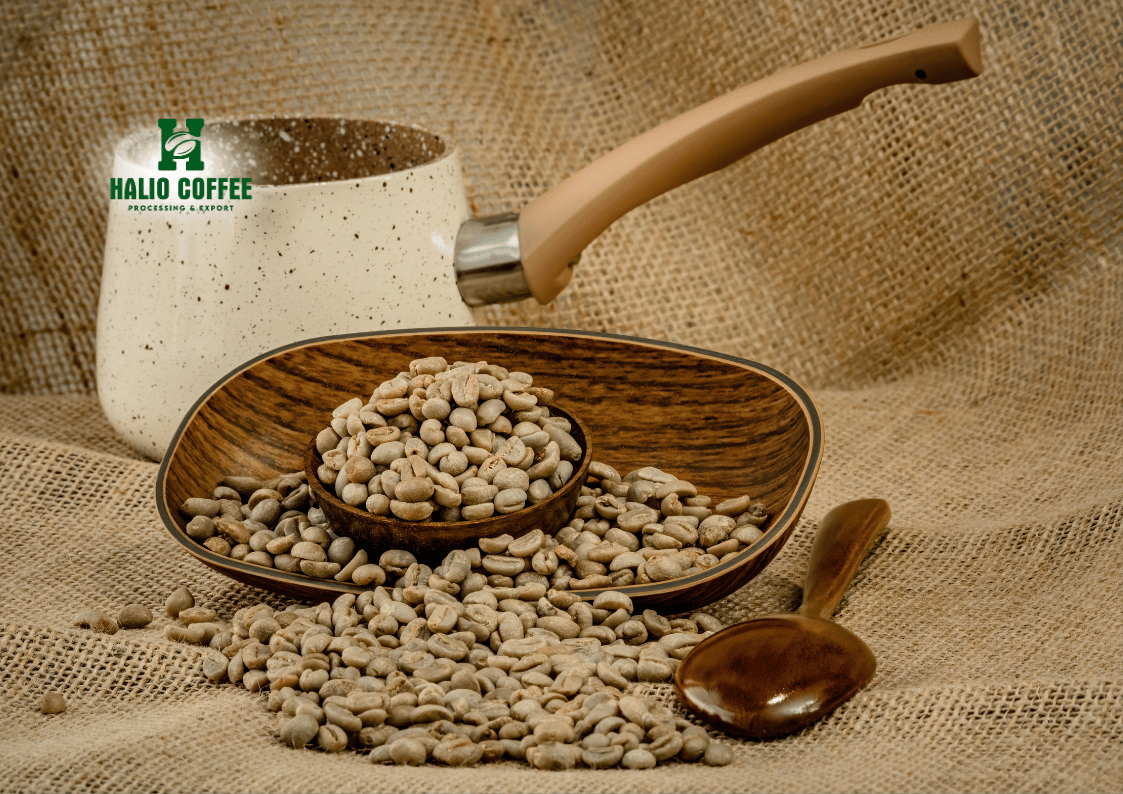
In the B2B context, “bulk” does not mean “generic.” It means “industrial consistency.” When evaluating offers for bulk green coffee beans, you must demand specific technical parameters to ensure the coffee performs predictably in large-scale roasting operations.
1. The Industrial Standard: Robusta Grade 1, Screen 18
This is the workhorse of the global industry.
- The Spec: Max 2% Black & Broken beans. Min 90% retention on Screen 18 (7.1mm).
- Why Screen 18? In large industrial roasters (Probat 500kg, Loring, etc.), thermal consistency is critical. Large, uniform beans absorb heat more evenly than mixed sizes, allowing for faster roast profiles without tipping or scorching.
- 2026 Quality Note: Due to favorable dry weather in the Central Highlands, the current harvest of Screen 18 beans is showing excellent density and color consistency.
2. The Strategic Upgrade: Wet Polished Robusta
As Arabica prices rise, roasters are desperately seeking functional substitutes. The most valuable bulk green coffee beans in 2026 are those that have undergone “Wet Polishing.”
- The Process: High-pressure water friction removes the silverskin and cleanses the bean surface.
- The Value Proposition: This process strips away the “earthy,” “woody,” and “rubber” notes often associated with dry-processed Robusta. It leaves a neutral, heavy-bodied cup that allows roasters to increase the Robusta percentage in a blend (e.g., from 30% to 50%) without the consumer detecting the shift.
- Procurement Advice: If you are blending for espresso or instant coffee, pay the premium for Wet Polished. It is cheaper than buying low-grade Arabica and offers better cup stability.
Sourcing Logistics: Moving Bulk Green Coffee Beans Efficiently
When you trade in volume, the logistics of moving the coffee determine your landed cost. The industry is rapidly shifting away from traditional bagging toward bulk liner solutions.
The Inefficiency of Jute Bags
- Standard: 60kg jute bags packed 320 to a container.
- Payload: Approx 19.2 Metric Tons per 20ft container.
- Drawback: Jute is breathable. In a humid container crossing the equator, bulk green coffee beans absorb moisture (“ship’s sweat”), leading to mold risk. Additionally, the labor required to debag 320 bags at the destination roastery is a significant operational cost.
The Efficiency of Bulk Container Liners
For contracts exceeding 100 tons, the bulk liner is the professional standard.
- The Method: A food-grade polyethylene liner is inflated inside the container. Coffee is blown in via conveyor belt or pneumatic blower.
- Payload: 21 Metric Tons per 20ft container.
- The Math: You gain nearly 2 tons of “free freight” per container compared to bags. Over a 50-container contract, that is 100 tons of coffee shipped with zero incremental ocean freight cost.
- The Protection: The liner acts as a hermetic seal, stabilizing the Water Activity (aw) and protecting the coffee from external moisture and odors.
The Compliance Landscape: EUDR and Bulk Procurement
If you are importing into the European Union, the procurement of bulk green coffee beans is complicated by the EU Deforestation Regulation (EUDR), which is now fully binding.
The “Commingling” Problem
Bulk coffee inherently aggregates beans from thousands of smallholders.
- The Mandate: You cannot import coffee without proof that it was produced on land that has not been deforested since 2020. This requires GPS polygons for every contributing farm.
- The Risk: Many cheap bulk offers lack this data. If you buy “stranded assets” (coffee without data), you cannot clear customs in Rotterdam or Hamburg.
- The Solution: When negotiating for bulk green coffee beans, demand a “Data Pack” validation before the contract is signed. Leading manufacturers are now using digital farm registries to segregate “EUDR Compliant” silos from “General Market” silos.
Risk Management: A Bulk Sourcing Checklist
Before finalizing a contract for bulk green coffee beans, run your potential partner through this rigorous technical audit. The volume of the trade magnifies the risk of “quality fade.”
1. The “Crop Year” Verification
With new crop trading 18% lower than old stock, suppliers have a massive financial incentive to mix in old, woody beans to clear dead inventory.
- The Test: Demand a Pre-Shipment Sample (PSS). Use a UV Light to inspect the raw beans. Old crop beans fluoresce; fresh crop beans do not.
- The Smell: Old crop smells like straw, wood, or burlap. Fresh crop smells grassy and vegetal.
- The Clause: Explicitly state “Crop Year 2025/2026 Only” in the contract.
2. Moisture Content and Water Activity
- The Spec: Max 12.5% Moisture.
- The Why: Bulk coffee retains heat. If bulk green coffee beans are loaded above 12.5%, the center of the bulk liner can reach temperatures that trigger fermentation or mold growth (Ochratoxin A).
- The Warning: Never accept a discount in exchange for waiving the moisture limit. You are buying a liability.
3. The Optical Sorting Audit
- The Requirement: Ensure the supplier uses Optical Color Sorters (Buhler/Sortex).
- The Why: Mechanical sieves remove small beans, but they cannot remove black beans of the correct size. Black beans cause the “phenol” taste defect. For a bulk blend, one phenol bean can ruin a batch.
Financial Engineering: Hedging Your Bulk Green Coffee Beans
Buying bulk green coffee beans is as much about finance as it is about coffee. In 2026, savvy buyers are using specific pricing models to manage risk.
The Currency Play (USD vs VND)
As of January 9, 2026, the Dollar Index (DXY) has risen to a 4-week high.
- The Impact: This exerts downward pressure on commodity prices.
- The Strategy: For buyers holding USD, your purchasing power in Vietnam is maximized. It is an optimal time to fix outright prices for bulk green coffee beans while the dollar is strong and the local market is soft due to pre-Tet selling.
Pricing Models
- Outright Price (Fixed): locking in the current low price (e.g., ~$3,928/ton FOB). Best for immediate shipment.
- PTBF (Price To Be Fixed): You agree on the differential (e.g., London + $0) now to secure the physical volume, but you fix the terminal price later. This is risky if you believe the market has hit bottom. Given the potential for a rebound post-Tet as farmers restrict sales, fixing the price now may be the safer bet.
Summary: Capitalizing on the Volume Opportunity
The procurement of bulk green coffee beans in Q1 2026 is an exercise in strategic arbitrage. You have the opportunity to leverage the 18% price correction in Vietnam to secure the high-volume foundation of your business, while simultaneously using those savings to hedge against the rising costs and climate risks of the Arabica market.
However, volume magnifies risk. A small quality issue in a micro-lot is an annoyance; in a 2,000-ton bulk contract, it is a financial disaster. The key to success lies in partnering with vertically integrated manufacturers who can execute “Wet Polished” quality, guarantee EUDR compliance via polygon mapping, and manage the logistics of bulk liners to optimize freight costs.
You have now secured the physical asset that anchors your supply chain. The final piece of the puzzle is determining the optimal financial structure for these large-scale contracts to protect your margin against currency shifts and market rallies.
- Elevating Your Supply Chain with Expert After-Sales Support from Coffee Suppliers
- The Art of Execution: Structuring a Strategic Green Coffee Order in 2026
- Coffee Prices Today Jan 9: Slight Decline Amidst Strengthening USD
- The Highland Jewel: A Buyer’s Guide to Vetting Lam Dong Arabica Coffee Suppliers
- Professional Guide to Raw Green Coffee Beans Supply in Vietnam