Mastering the Sample Testing Process with Coffee Suppliers
Dec
In our strategic examination of long-term coffee supply contracts, we established the critical financial and legal framework necessary for partnership longevity. You now have a signed agreement with your Vietnamese green coffee beans supplier, guaranteeing price and volume stability over multiple crop cycles.
However, a contract is only as good as the physical product it reserves. The ultimate point of risk, and the gateway through which all coffee must pass before shipment, is the sample testing process with coffee suppliers.
This process is where the theoretical contract specifications—a maximum of 2% Black Beans, 12.0% Moisture, a specific cup profile—are translated into a tangible, actionable “Yes” or “No.” Approving a bad sample is legally accepting a flawed product, negating all your meticulous negotiation efforts.
This guide is your expert protocol for managing the entire sample lifecycle in Vietnam. We will dissect the three crucial types of samples (PFS, PSS, and Arrival), detail the physical and sensory tests required for a premium Robusta or Arabica lot, and provide the definitive audit checklist to ensure that the coffee you approve in your lab is the coffee that ultimately lands at your port.
The Three Stages of Sample Testing: A Strategic Timeline
The sample testing process with coffee suppliers is not a single event; it is a three-stage quality filter designed to catch defects at the earliest, least costly point.
Stage 1: The Pre-Feasibility Sample (PFS)
This is the “dating” phase.
- Purpose: To determine if the supplier (e.g., Halio Coffee Co., Ltd) can even meet your required Type Sample (the target quality standard you set). The PFS usually comes before the contract is finalized.
- Action: The supplier sends a generic sample of their current crop.
- Buyer’s Test: Focus on Cup Profile (flavor notes), Moisture Stability, and Visual Consistency (overall color, size distribution). This test determines if you proceed to contract negotiation.
Stage 2: The Pre-Shipment Sample (PSS)
This is the “final inspection” phase, the most critical step.
- Purpose: To confirm that the specific physical lot (or batch) currently staged in the supplier’s warehouse—the one destined for your container—meets the exact specifications of the signed contract.
- Action: The supplier’s Quality Assurance (QA) team draws a composite sample from the prepared bags, which is then sealed and dispatched to your lab.
- Buyer’s Test: This is a comprehensive physical, chemical, and sensory analysis against the Type Sample. Approval of the PSS legally binds you to accept the container, pending a final “On-Arrival” check.
Stage 3: The Arrival Sample (A/S)
This is the “final verification” phase.
- Purpose: To confirm that the coffee did not degrade during the 30-45 days of ocean transit.
- Action: A sample is drawn by a third-party inspector (e.g., SGS, CafeControl) at the port or your warehouse.
- Buyer’s Test: Focus primarily on Moisture Content and Sensory Degradation (checking for “baggy” or “woody” flavors caused by high transit humidity).
Physical Analysis: The Non-Negotiable Metrics
Before the coffee ever touches water, it must pass the physical gauntlet. The physical analysis protects your equipment and ensures compliance with the Vietnam coffee grading system (e.g., TCVN 4193:2014).
1. Moisture Content (The Shelf Life Metric)
- Standard: Max 12.5% (The safety ceiling).
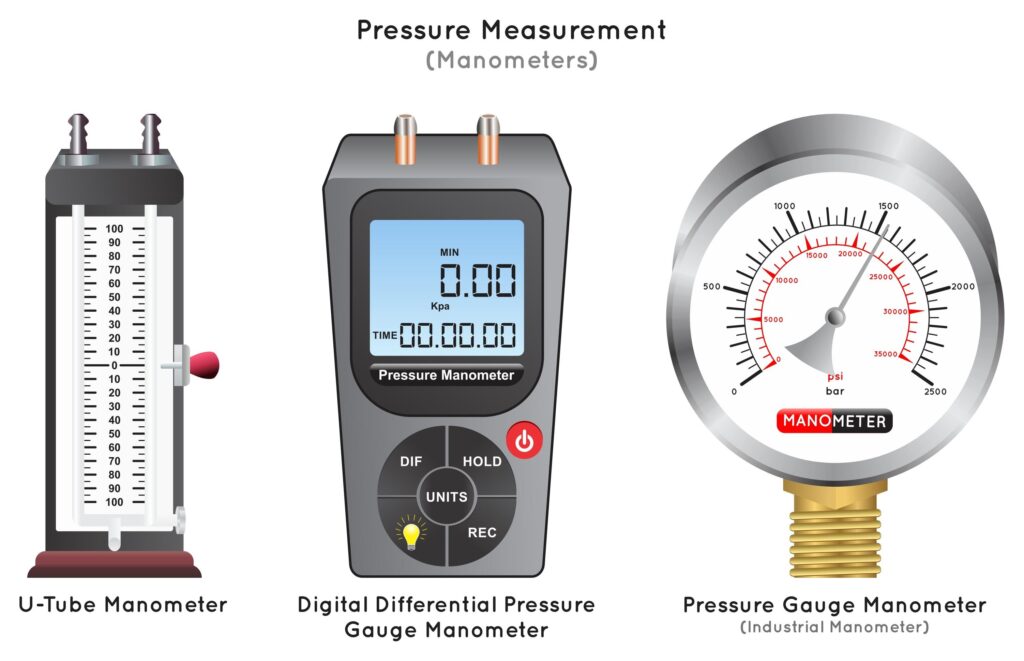
- Test: Use a calibrated digital moisture meter (Sinar, Dickey-John).
- Expert Insight: Never accept 12.5%. Aim for a tighter contractual window of 11.5% – 12.0%. This gives you a safe margin for the inevitable humidity exposure during ocean transit. If the sample is approved at 12.4%, it risks arriving at 13.0%.
2. Defect Analysis (The Grading Check)
This process confirms the supplier’s commitment to your Grade 1 contract.
- Standard: TCVN 4193:2014 requires analysis of a 300g sample.
- Action: Hand-sort the sample to count:
- Black/Broken Beans: (Contract max 2.0%).
- Foreign Matter: (Contract max 0.5%).
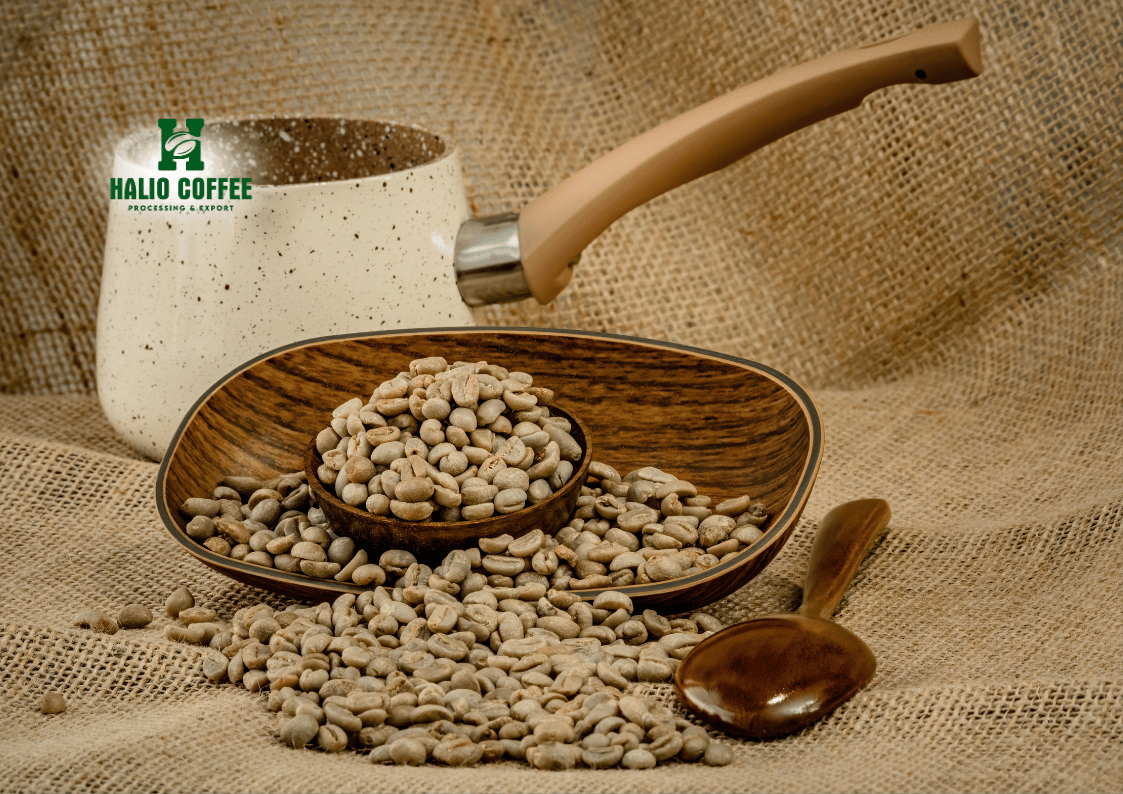
- Verification: If your supplier, like Halio Coffee Co., Ltd, specializes in highly clean Screen 18 lots, the PSS should show near-zero defects, not just barely meet the 2.0% maximum.
3. Water Activity (aw)
- Definition: A measure of the free, unbound water available for microbial growth.
- Standard: Green coffee should be below aw=0.65.
- Expert Insight: While not yet standard in commercial contracts, this test is the ultimate predictor of mold risk. It can flag a bean that is physically dry (12.0% moisture) but chemically susceptible to mold.
Sensory Analysis: The Flavor Guarantee
The sample testing process with coffee suppliers requires sensory verification. This ensures the bean meets your flavor profile before you commit to roasting.
1. Cupping Protocol
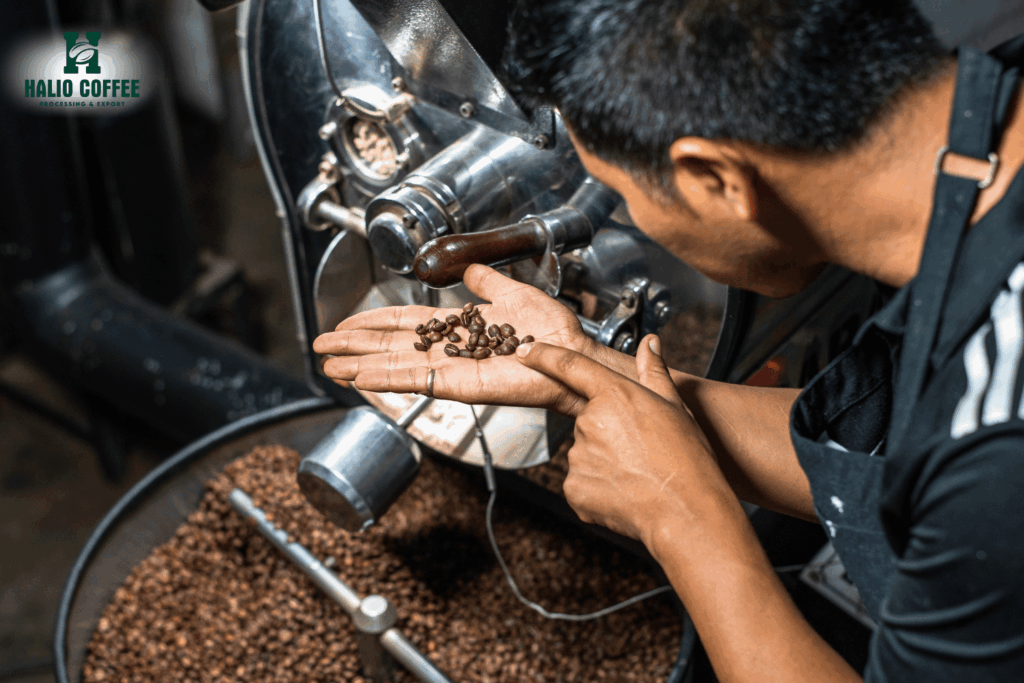
- Action: Roast a small portion of the PSS sample to a standardized medium-dark color (e.g., Agtron 50) without blending. Grind and cup (using the SCA/CQI protocol for Arabica/Robusta).
- The Focus (Robusta): Check for Cleanliness, Body, and the absence of common Vietnamese faults:
- “Woody/Stale”: Indicates old crop mixed in.
- “Phenolic/Medicine”: Indicates contamination or severe fermentation error.
- “Rubbery”: The classic under-developed Robusta flavor.
- The Comparison: Cup the PSS blind against your approved Type Sample. The PSS must match the flavor profile of the Type Sample.
2. Micro-Roast Test
- Action: Roast a larger batch (e.g., 500g) of the PSS sample using your standard production profile.
- The Focus: Run the sample through your grinder and commercial espresso machine/brewer.
- The Goal: Does the PSS behave consistently? Does it grind correctly? Is the resulting color and crema acceptable? A slight change in density in the PSS can throw off your entire grinder setting and product yield.
The Audit Checklist: Managing the Sample Flow
The logistics of samples—shipping, timing, and storage—are often where breakdowns occur. A strategic buyer manages this administrative process as rigorously as the sensory test.
1. Sample Request Protocol
- The Rule: Always send a pre-paid shipping label (e.g., FedEx, DHL) to your Vietnamese green coffee beans supplier.
- Why: This ensures the sample is shipped immediately (no delays waiting for them to pay freight), and you control the tracking and documentation.
- Documentation: Demand a PFS/PSS Certificate from the supplier listing:
- Lot Number: Unique ID of the physical coffee.
- Date Sampled: (Must be recent).
- Shipping Weight: (Verification the sample is representative).
2. The Sample Storage Clause
Once you approve the PSS, you must reserve a portion of that approved sample.
- The Action: Upon approval, demand that the supplier seal and reserve a 1kg portion of the PSS at their facility (e.g., Halio’s warehouse at 193/26 Nguyen Van Cu).
- The Purpose: This “Sealed Reference Sample” is the legal arbiter if a dispute arises later. If the coffee arrives flawed, you and the supplier send your respective sealed samples to a third-party lab (e.g., SGS) for a conclusive comparison.
3. PSS Rejection Protocol
If the PSS fails (e.g., 13.5% Moisture), the rejection must be immediate and formal.
- Action: Send a formal “Non-Acceptance Notice” citing the specific parameter failure (e.g., “Moisture Content (13.5%) exceeds contractual limit (12.0%)”).
- The Negotiation: The supplier must re-work the lot (re-dry or re-sort) at their cost and send a new sample (PSS Ref. 2).
Strategic Pitfalls and Red Flags
The sample testing process with coffee suppliers is a high-risk area for fraud and error. Watch for these warning signs:
- 🚩 The “Perfect” Sample: The supplier sends a sample that is visibly immaculate (zero defects, perfect color), but their factory operates on old machinery. This suggests the sample was hand-sorted and is not representative of the final container. Action: Demand the sample be drawn by a third-party inspector.
- 🚩 The Old PSS: The supplier sends a PSS that is 3 months old.
- The Risk: They likely sold the fresh lot and are now trying to fill your contract with old, fading stock. Reject immediately.
- 🚩 The “Pre-Roast” Sample: A supplier sends a small sample that is already roasted.
- The Risk: They are hiding defects (black beans are harder to spot in roasted form). Only approve samples based on green bean analysis.
- 🚩 Discrepancy in Density: The sample is approved at a high density, but the arrival coffee is light (low density). This can happen if the supplier blends the approved sample with a cheaper, faster-growing lot. Action: Include a clause in your contract that specifies a minimum density (g/mL) based on the approved PSS.
Strategic Conclusion: Verification as Partnership
Mastering the sample testing process with coffee suppliers is the final step in securing your Vietnamese green coffee beans supplier relationship. It is the moment you translate legal intent into physical commitment. It ensures that all the meticulous work done on long-term coffee supply contracts—the price fixations, the quality specs, the safety compliance—is physically honored.
By treating the PSS process with scientific rigor, you build trust. When a supplier knows you will test every metric, they internalize that discipline, making your entire supply chain more reliable.
However, the purchase order only covers the coffee up to the port of entry. The best partnerships extend far beyond the transfer of title. The real test of a supplier is their commitment to your success after the documents have cleared. What happens when you receive the goods and discover a packaging defect, a quality issue on the 10th bag, or need help troubleshooting a roast profile?
A world-class partner views the clearing of customs not as the end of the transaction, but as the beginning of the relationship.
Read Next: After-sales support from coffee suppliers
- Gia Lai Robusta Green Coffee: Vietnam’s High-Potential Coffee Origin for Global Buyers
- Coffee Prices Today, November 4th: Prices Skyrocket on Fears of Storms Affecting Vietnam’s Harvest
- Coffee Prices Today, Nov 15: London’s 5th Consecutive Drop, Domestic Prices Fall Below 110,000 VND/kg
- The B2B Sourcing Guide: How to Vet and Partner with a World-Class Green Bean Coffee Company
- The Global Powerhouse: A 2026 Strategic Analysis of Vietnam Green Coffee Beans