The Execution Phase: A Buyer’s Manual to Order Green Coffee Beans Direct from Origin
Dec
In our previous strategic analysis, we established the economic imperative of sourcing bulk raw coffee beans. We demonstrated that moving from spot-market purchasing to container-load volume is the only way to secure true margin control and traceability.
But strategy is nothing without execution.
The moment you decide to order green coffee beans from an international supplier, you are no longer just a roaster; you are an importer. You are stepping into a complex ecosystem of international law, finance, and logistics. A mistake in this phase—a typo on a Bill of Lading, a misunderstood payment term, or a missed customs filing—can cost you thousands of dollars in demurrage fees or result in a lost shipment.
This guide is your tactical manual for execution. We will move beyond the theory of sourcing to the practice of ordering. We will dissect the Purchase Order (PO), demystify the payment instruments (T/T vs. L/C), and provide a step-by-step checklist to ensure that the coffee you contracted is the coffee that lands at your door.
The Pre-Order Foundation: What You Need Before You Click “Send”
Before you place an order with a Vietnamese green coffee beans supplier like Halio Coffee Co., Ltd, you must have your infrastructure in place. You cannot order green coffee beans first and figure out the logistics later.

1. The Logistics Partner (Your Freight Forwarder)
Do not try to be your own travel agent. You need a licensed Freight Forwarder and Customs Broker in your home country.
- The Role: They will book the ocean freight (if buying FOB), handle the ISF filing (for USA), pay the duties, and arrange the truck to your warehouse.
- The Action: Open an account with a forwarder before you sign a contract.
2. The Banking Infrastructure
International trade moves on USD.
- The Requirement: You need a bank account capable of sending international wire transfers (SWIFT).
- The Reality: Small banks often have poor exchange rates and slow processing times. Consider using a specialized FX broker for larger transactions to save 1-2% on currency conversion.
3. The Warehouse
Where is the container going?
- The Requirement: A 20ft container holds 320 bags. That is 20 pallets. Do you have a loading dock? Do you have a forklift?
- The Alternative: If you don’t, you must arrange for a “tailgate delivery” or have the container stripped at a third-party warehouse.
The Contractual Architecture: Structuring the Purchase Order
A professional order is not an email saying “I’ll take it.” It is a formal Purchase Order (PO) or Sales Contract. When you order green coffee beans, this document governs everything.
1. The Product Specification (The “What”)
Never be vague. Use the technical language we learned in the green coffee price guide.
- Bad: “1 Container Vietnam Robusta.”
- Good: “320 Bags (60kg Net) Vietnam Robusta Grade 1, Screen 18, Wet Polished. Max 0.1% Black Beans. Moisture Max 12.5%. Packing in Jute Bags with GrainPro.”
- Why: If the coffee arrives with 2% black beans, you can only claim a refund if your contract specified “Max 0.1%.”
2. The Price and Incoterm (The “How Much”)
- Price: “USD $4,650 per Metric Ton.” (Or, for PTBF contracts: “London Jan ’26 + $450/MT Differential”).
- Incoterm:FOB Ho Chi Minh City.
- Note: As discussed, FOB puts you in control of the freight. It is the professional standard.
3. The Payment Terms (The “When”)
This is the most critical financial negotiation.
- Standard Terms: 30% Deposit (T/T) to start production; 70% Balance (CAD) against scan of shipping documents.
- Why this works: The deposit covers the supplier’s raw material cost (buying cherries from farmers in Dak Lak). The balance is paid only after you see proof (Bill of Lading) that the coffee is on the ship.
4. The “Subject To” Clauses (The Safety Net)
Always include these two clauses:
- “Subject to Approval of Pre-Shipment Sample (PSS).” This gives you the right to cancel or demand re-processing if the final sample doesn’t match your quality standards.
- “Subject to passing FDA/Customs inspection.” This protects you if the coffee is rejected at the border for safety reasons (e.g., pesticides).
The Execution Timeline: A Step-by-Step Guide to Order Green Coffee Beans
You have the contract. Now, follow this timeline to execute the order.
Step 1: The Deposit and Production (Weeks 1-2)
- Action: You wire the 30% deposit.
- Supplier Action: Halio Coffee receives the funds. They begin the milling, polishing, and color-sorting process at their facility in Dak Lak.
- Your Job: Wait. Do not harass the supplier. Good processing takes time.
Step 2: The PSS Approval (Week 3)
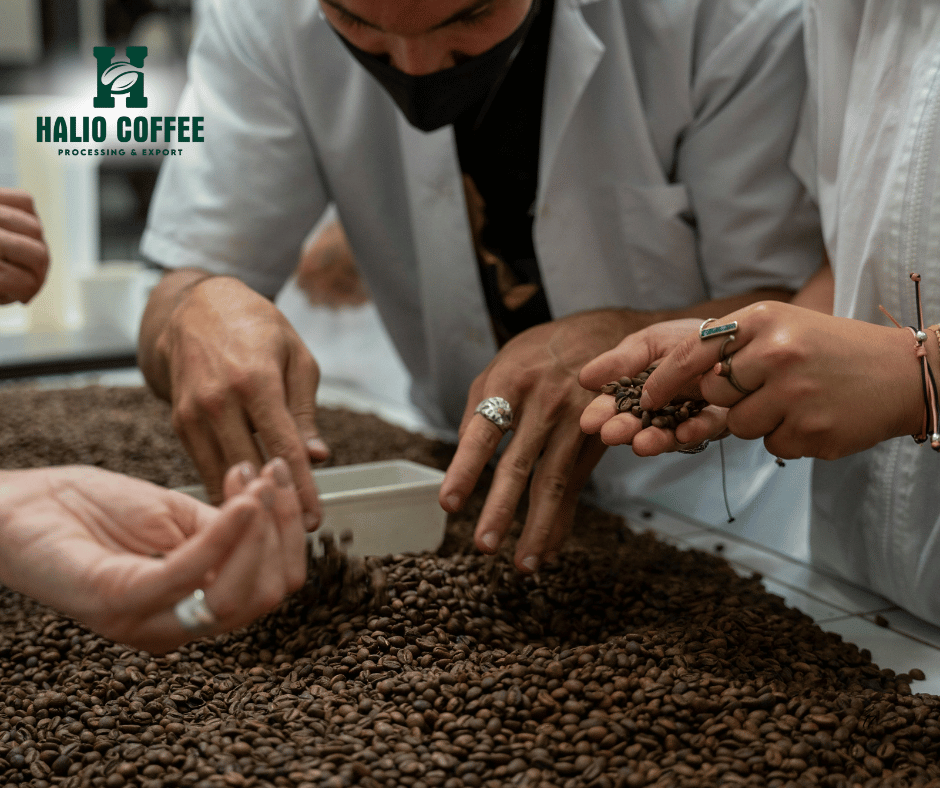
- Action: The supplier sends you a 1kg PSS via DHL.
- Your Job: Roast and cup it immediately.
- The Decision:
- Pass: Email “PSS Approved. Proceed to shipment.”
- Fail: Email detailed feedback (e.g., “Too many quakers,” “Moisture reading is 13%”). Demand re-sorting and a new sample.
Step 3: The Booking and Shipping (Week 4)
- Action: You send your Freight Forwarder’s contact details to the supplier.
- Supplier Action: They contact your forwarder to book the container. They stuff the container, seal it, and truck it to the port (e.g., Cat Lai).
- Critical Check: Ask for “Stuffing Photos.” You want to see photos of the empty container (to prove it’s clean) and the full container with the seal in place.
Step 4: The Document Review (Week 5)
- Action: The ship sails. The supplier generates the documents.
- Your Job: They will send you DRAFTS (PDFs) of the Bill of Lading, Invoice, and Cert of Origin.
- CRITICAL: Check every letter. Does the weight match? Is your address correct? Is the HS Code correct?
- Why: A typo on the Bill of Lading can cost $500 to fix later. Fix it now on the draft.
Step 5: The Balance Payment (Week 6)
- Action: You approve the drafts. The supplier sends the Final Scanned Documents.
- Your Job: Wire the 70% balance.
Step 6: The Release (Week 7)
- Action: The supplier receives the money.
- The Telex Release: They instruct the shipping line to “release” the cargo to you electronically. You do not need the paper Bill of Lading; it is done digitally.
Red Flags: Warning Signs During the Order Process
Even after you’ve vetted a supplier, watch out for these behaviors during the ordering phase.
- 🚩 The “Sudden Price Hike”: You sign a contract, and a week later the supplier says, “The farm price went up, I need $200 more per ton.”
- Verdict: Unprofessional. A contract is a contract. If they can’t honor it, they are not a reliable partner.
- 🚩 The “Shipping Delay” Excuse: “We can’t get a booking.”
- Verdict: Often a lie to cover up production delays. Ask for the “Booking Rejection Notice” from the shipping line. If they can’t show it, they haven’t finished milling the coffee.
- 🚩 The “Document Hostage”: They refuse to show you draft documents until you pay the balance.
- Verdict: Dangerous. You must see proof of shipment before paying the balance.
Conclusion: The Professional Importer
To order green coffee beans directly from origin is to take control of your business’s destiny. It is the move that separates the “coffee shop” from the “coffee company.”
By following this rigorous process—structuring the contract, managing the logistics, and verifying the quality at every step—you eliminate the mystery of the supply chain. You replace “hope” with “process.”
You have now mastered the global supply chain. You know how to find the best green coffee beans, negotiate the price, and execute the import.
But what if you are just starting? What if you are a home roaster, a nano-roaster, or a startup that needs access to this quality but cannot yet buy a pallet? You need to find a source that bridges the gap between the 60kg bag and the 1kg bag.
It is time to explore the local options. It is time to look for raw coffee beans near me.
- Coffee Prices Today September 13: Arabica Hits 4-Month High, Robusta Extends Rally
- The Strategic Procurement of 2026: A Professional Guide to Buying Raw Coffee Beans
- How to Identify and Source the Best Green Coffee Beans
- Coffee Prices Today, September 1: Sharpest Monthly Surge in Over a Decade
- Coffee Prices Today, August 28: Sharp Gains as Robusta Surpasses $5,000/ton