The Strategic Pivot: Vetting Vietnam Robusta Green Bean Suppliers in 2026
Jan
In the complex architecture of the global coffee trade, the entity you sign the contract with is often more important than the contract itself. As we navigate the opening weeks of 2026, the role of Vietnam Robusta green bean suppliers has fundamentally shifted. No longer are they merely logistical conduits for moving bags from the Central Highlands to Ho Chi Minh City ports. In a market defined by “structural vulnerability” and rigorous compliance mandates like the EUDR, these suppliers have become the primary risk managers for the global coffee industry.
For the professional roaster and procurement director, the current landscape offers a paradox. On one hand, we are witnessing a “Buyer’s Window” of unprecedented opportunity, with domestic prices in Vietnam correcting by approximately 18%. On the other, the risks of “quality fade” and compliance failure have never been higher.
This guide is your executive manual for navigating this ecosystem. We will move beyond the surface-level directories to provide a rigorous, analytical framework for selecting partners. We will dissect the difference between “Traders” and “Manufacturers,” analyze the specific infrastructure required to produce “Wet Polished” grades, and provide a due diligence checklist to ensure that the Vietnam Robusta green bean suppliers you choose can deliver resilience, quality, and value.
The Ecosystem: Categorizing Vietnam Robusta Green Bean Suppliers
To source effectively, one must understand that the term “supplier” in Vietnam covers a vast spectrum of operational capabilities. Treating a local collector the same as a vertically integrated manufacturer is a procurement error that leads to contract default.
1. The Collector (Đại Lý)
These are the ground-level aggregators. They operate at the village level, buying fresh cherries or parchment directly from smallholder farmers.
- Role: Liquidity provision to farmers.
- Risk: They rarely have processing equipment beyond basic drying patios. They cannot control screen size or defect count to export standards.
- Verdict: Do not contract directly unless you have your own milling infrastructure in-country.
2. The Commercial Trader
These entities dominate the volume trade. They buy semi-processed coffee from collectors and aggregate it for export.
- Operational Model: They are financial intermediaries. They often do not own the dry mills or optical sorters; they rent milling time or buy “FAQ” (Fair Average Quality) and blend it to meet a contract.
- 2026 Risk: In a falling market (prices down 18%), traders operating on thin margins are the most likely to “blend down”—mixing in lower grades or old crop to save pennies.
- Verdict: Acceptable for low-grade industrial volume, but risky for quality-sensitive programs.
3. The Vertically Integrated Manufacturer
These are the premier Vietnam Robusta green bean suppliers. Companies (like Halio Coffee) that own the entire processing chain: the wet mill, the drying patios, the dry mill, and the optical sorting lines.
- Operational Model: They control the asset. They can “manufacture” a specific grade (e.g., Wet Polished, Screen 18) by adjusting their machinery.
- 2026 Advantage: Because they own the infrastructure, they can guarantee the “Crop Year” and provide the geolocation data required for EUDR compliance.
- Verdict: The strategic partner of choice for 2026.
Market Analysis: Why Partner with Vietnam Robusta Green Bean Suppliers Now?
Why is Q1 2026 the critical moment to solidify your supplier relationships in Vietnam? The answer lies in the data. The market is currently experiencing a “liquidity event” that smart procurement teams are leveraging.
The Price Correction Opportunity
The most compelling argument for engaging Vietnam Robusta green bean suppliers right now is the cost basis.
- The Data: As of January 8, 2026, green coffee prices in the domestic market are trading between 97,500 and 98,300 VND/kg.
- The Delta: This represents a sharp decrease of approximately 18% (21,000 – 21,400 VND/kg) compared to the peaks of 2025.
- The Driver: This is driven by “aggressive selling” from farmers clearing inventory before the Tet Lunar New Year. Suppliers are currently flushed with stock and eager to move volume, giving buyers significant negotiation leverage.
The Export Velocity
While other origins are struggling, Vietnam Robusta green bean suppliers are proving their logistical resilience.
- Volume Surge: In the first two months of the 2025-2026 crop year, exports hit 2.63 million bags, a massive 51.9% increase year-on-year.
- Reliability: Unlike Brazil (where exports dropped 27% in Nov 2025) or Indonesia (flooding risks), Vietnamese suppliers are the only ones currently capable of guaranteeing prompt shipment for large volumes.
The Rise of Value-Added Processing
In 2026, the best Vietnam Robusta green bean suppliers are no longer just selling “Grade 1.” They are selling technology-driven solutions to global roasting challenges.
The “Wet Polished” Standard
With Arabica prices rising due to climate shocks in Brazil, roasters are asking suppliers to upgrade their Robusta.
- The Technology: Advanced suppliers utilize high-pressure hydro-friction machines.
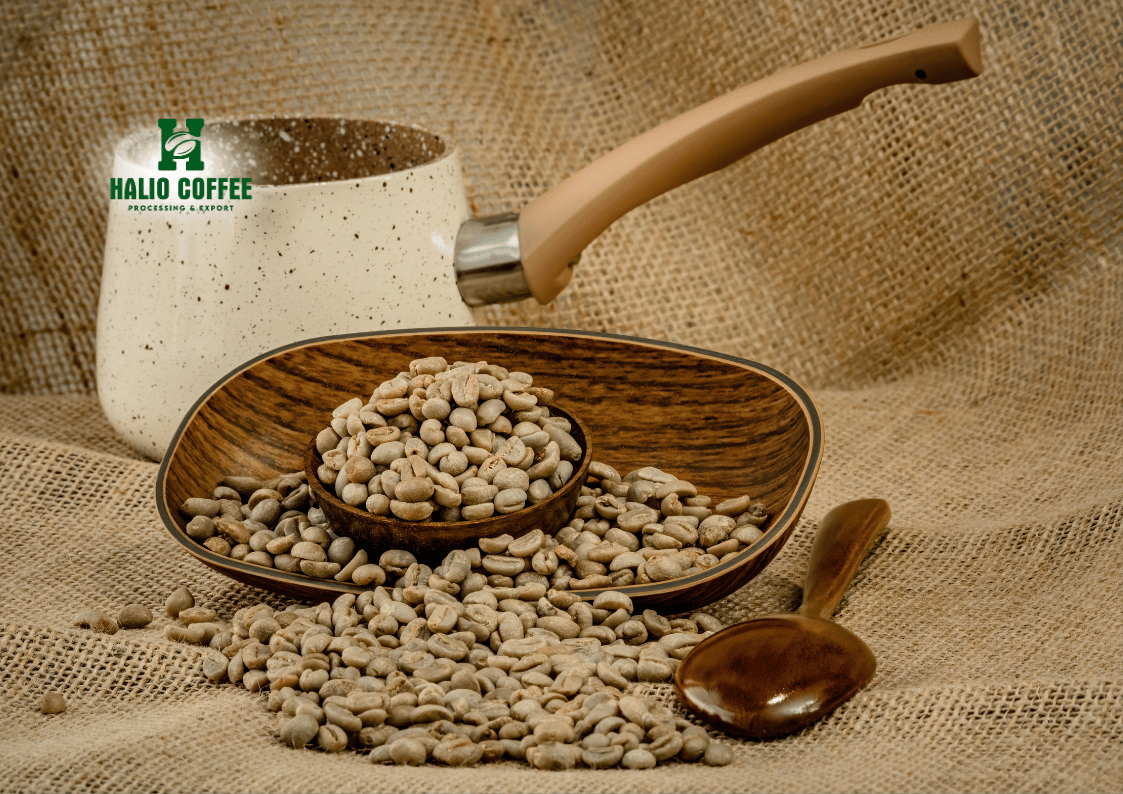
- The Result: This strips away the silverskin and cleanses the bean of mucilage residues. The resulting “Wet Polished” bean is visually identical to high-grade washed Arabica and possesses a neutral, clean cup profile.
- The Vetting Question: Ask your supplier: “Do you own your own polishing line, or do you outsource it?” Outsourced polishing often leads to delays and moisture inconsistencies.
Optical Sorting Precision
For premium contracts (0.1% defects), mechanical grading is insufficient. Top-tier Vietnam Robusta green bean suppliers must employ Buhler or Sortex optical color sorters. These machines use cameras to eject black beans (which cause phenol taste) and foreign matter. A supplier without this technology cannot guarantee a “Clean Cup.”
The Compliance Hurdle: EUDR and Traceability
If you ship to Europe, the capability of your Vietnam Robusta green bean suppliers to manage data is just as important as their ability to manage coffee.
The 2026 Mandate
The EU Deforestation Regulation (EUDR) is now a binding constraint.
- The Requirement: Every shipment must be linked to the specific plots of land where the coffee was grown, proving no deforestation post-2020.
- The Supplier’s Burden: The supplier must map thousands of smallholder farms and aggregate this into a data pack (polygons) for the buyer.
- The Audit: Before signing a contract, request a demo of the supplier’s traceability system. If they provide a static PDF or a general “Regional Certificate,” they are non-compliant. Leading suppliers are investing in digital farm registries to solve this.
A Due Diligence Framework for Selection
When evaluating Vietnam Robusta green bean suppliers, do not rely on email communication alone. Use this audit framework to verify their capabilities.
Step 1: The Infrastructure Audit
Request a video tour or a site visit. Look for:
- Silos: Does the facility have vertical storage silos? (Indicates volume management and moisture control).
- Flooring: Is the warehouse floor epoxy-coated? (Prevents dust and contamination).
- The Lab: Do they have a QC lab with moisture meters (Sinar/Dickey-John) and sample roasters? A supplier without a lab is flying blind.
Step 2: The Financial Health Check
In a falling market (prices down 18%), suppliers holding expensive old stock may be facing liquidity crises.
- The Check: Request references from their logistics partners (forwarders/trucking companies). If a supplier is slow to pay their truckers, they will be slow to ship your coffee.
- Payment Terms: Be wary of suppliers demanding 100% advance payment. Standard terms for established partners are CAD (Cash Against Documents) or LC (Letter of Credit).
Step 3: The “Crop Year” Verification
With new crop trading significantly lower than old stock, there is a high risk of “blending” past crop beans.
- The Smell Test: Demand a Pre-Shipment Sample (PSS). Old crop smells woody/straw-like. New crop smells grassy/fresh.
- The UV Test: Ask if the supplier uses UV light sorting. Old beans fluoresce differently. A transparent supplier will confirm the crop year on the Certificate of Origin.
Technical Specifications to Demand
When contracting with Vietnam Robusta green bean suppliers, specificity is your shield against “quality fade.”
| Parameter | Standard Spec | Premium Spec (Demand This) | Why? |
| Moisture | Max 13.0% | Max 12.5% | Prevents mold/OTA during transit. |
| Defects | Max 2% | Max 0.1% (Black/Broken) | Ensures clean cup/no phenol. |
| Screen Size | 90% > S18 | 95% > S18 | Better roast uniformity. |
| Packaging | Jute Bag | GrainPro / Bulk Liner | Preserves freshness/color. |
| Crop Year | Current | 2025/2026 Only | Avoids “woody” old stock. |
Red Flags: Commercial Malpractice to Avoid
Be vigilant against these warning signs when dealing with Vietnam Robusta green bean suppliers.
- 🚩 The “Negative Differential” Trap: If a supplier offers a price significantly below the replacement cost (London Terminal – Differential), they are likely planning to default or ship defective goods. There is no “free lunch” in the commodity market.
- 🚩 The “Moisture Inflation”: A supplier insists on 13% or 13.5% moisture. They are selling you water at the price of coffee. This is a common tactic to recover margin in a bear market.
- 🚩 The “Ghost Mill”: The supplier claims to be a manufacturer but refuses a factory visit (virtual or physical) citing “proprietary secrets.” Coffee milling is not a secret; they are likely hiding the fact that they are a trader working out of a rented warehouse.
Conclusion: The Strategic Partnership
Partnering with the right Vietnam Robusta green bean suppliers in 2026 is a strategic masterstroke. It grants you access to the world’s most robust supply chain at a price point that has corrected by 18%, allowing you to hedge against global volatility.
However, the window to secure these terms is finite. As the “aggressive selling” pre-Tet subsides, the power balance will shift. The optimal strategy is to lock in your core volume now with a vertically integrated manufacturer who can guarantee “Wet Polished” quality and EUDR compliance.
You have now built the framework for a resilient supply chain. The final step is to execute the purchase at the right financial moment.
- Coffee Prices Today, October 23rd: Continue Strong Rally, Reaching 5-Week High
- Coffee Prices Today September 13: Arabica Hits 4-Month High, Robusta Extends Rally
- Mastering the Art of Building Relationships with Coffee Farmers in Vietnam
- A comprehensive analysis of the characteristics, processing methods, industrial applications, and market dynamics in Dak Lak province.
- Navigating the World of Green Coffee Bean Distributors